Sunday, May 21, 2006

Fungal mimics

Mimicry is a fascinating and widespread phenomenon where one organism gains some benefit by resembling another organism or thing. This resemblance can take many forms including visual, chemical and molecular mimicry.

A mini review in FEMS Microbiology Letters (1) has stimulated my interest in the little known mimetic interactions of plants and fungi.

There are several ways that fungi can imitate plants and manipulate them or use them to manipulate other organisms. One particularly fascinating mechanism is the production of ‘pseudoflowers’ that is structures formed from the leaves of a plant infected by fungi that resemble flowers, they also smell like flowers and exude sweet liquid as a reward. This liquid contains fungal spores and when pollinating insects land on the pseudoflowers they pick up spores and transfer them to other flowers that the fungus can then infect. I am just amazed by this type of manipulation, it will be fascinating to learn just how this remarkable feat is achieved and how it evolved.

(A) Uninfected flowering Euphorbia cyparissias plant and (B) E. cyparissias infected by the rust fungus Uromyces pisi. (2)


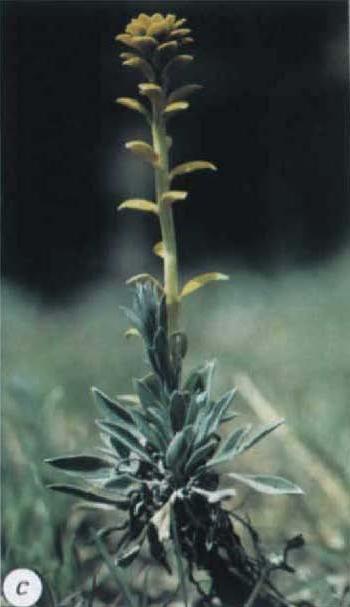
Pseudoflower of an Arabis produced by the fungus puccinia monoica (3)


Fungi can also act as molecular mimics tricking the host plant into thinking that they are grains of pollen. This allows them a fantastic entry route into the plant bypassing the physical barriers found in the rest of the plant. The Stigmas of plants have evolved to capture pollen grains from the air. The normal pollen floats in the air in a similar ways to fungal spores and so end up on stigmas in a similar way. There is also some evidence that molecules on the surface of the growing fungus contain similar molecules to pollen. A similar trick is accomplished by several pathogens where surface molecules resemble those of the host.

While writing this I saw an interesting post at Thomasburg walks via the carnival of animalcules. I am not sure if they are flower mimics, they certainly look like flowers. It would be interesting to find out if they attracted pollinating insects to disperse them, or if in this case the resemblance to flowers in coincidental.

Refs:

1) Mimicry in plant-parasitic fungi
Henry K. Ngugi & Harald Scherm
FEMS Microbiol Lett 257 (2006) 171–176

2) POLLINATOR-MEDIATED INTERACTIONS BETWEEN A PATHOGENIC FUNGUS, UROMYCES PISI (PUCCINIACEAE), AND ITS HOST PLANT, EUPHORBIA CYPARISSIAS (EUPHORBIACEAE).
MONIKA PFUNDER AND BARBARA A. ROY
American Journal of Botany 87(1): 48–55. 2000.

3) Floral mimicry by a plant pathogen
B. A. Roy
Nature 362, 56 - 58 (04 March 1993) ; doi:10.1038/362056a0

http://evolution.uoregon.edu/Publications.htm

Monday, May 15, 2006

Tutankhamun archive to go online

According to The Guardian the whole of the archive related to the excavation of the tomb of Tutankhamun is goinf to be made available online:

"Between 1922 and 1930, at least 5,398 objects were removed. Carter and his colleagues made meticulous index cards, notes and sometimes drawings of each find, and kept diaries and records of their progress. All of which went to Oxford, where they have been preserved since Carter's death in 1939.

From then, research progress has been slow, Dr Jaromir Malek, of the Griffith Institute in Oxford, told a Bloomsbury Academy conference in London last Saturday. "We came to the conclusion that probably 20% of the material had been properly published, and if the current rate of progress was going to continue it would probably take another 200 years," he said.

The Oxford archive, as it stands, will be entirely online within two years."

Here are links to what is currently available:

Tutankhamun: Anatomy of an Excavation is ambitious in its scope but simple in its aims: to make the complete records of Howard Carter's excavation of the tomb of Tutankhamun available on these web pages.

The Search for Tutankhamun. (Howard Carter's records of the five seasons of excavations, financed by Lord Carnarvon, in the Valley of the Kings 1915 - 1922).

The state of British butterflies

A new report called 'The state of butterflies in Britian and Ireland' by the charity Butterfly Conservation has just been resleased.

It present s a mixed picture of the state of british butterflies. Some have done quite well but many other gave continued to decline. It seems that generalists who can cope with different environments are doing quite well but specialists that rely on particular habitats have done badly. There is also evidence of range expansion of some species probably because of climate change. This is ok for species that are able to move to a new habitat, if you are a species that relies on a small patch of habitat then it's bad news.

Hopefully this survey will provide clues as to how our butterflies can be conserved and unline the importance of climate change to many species.

Some of the data from the BBC:

Painted Lady (+31%)
Red Admiral (+30%)
Marsh Fritillary (-32%)
White-letter Hairstreak(-68%)
Pearl-bordered Fritillary (-77%)
High Brown Fritillary (-82%)
Source: Butterfly Conservation, figures for 1995-2004 survey, compared to 1970-1982

Friday, May 05, 2006

New Ediacaran type fossil

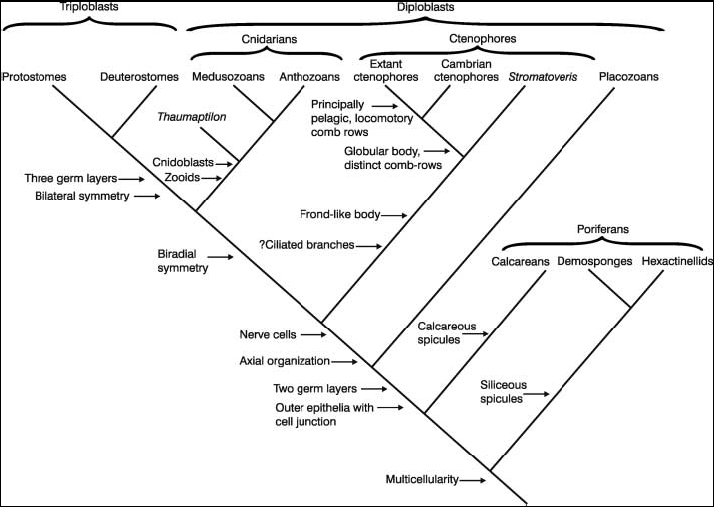
Stromatoveris (click for bigger)

In the current issue of Science (5 May 2006) There is a description of an amazing new fossil from the Chenjiang lagerstatte in China (1).

I have written about the Ediacaran (Vendian) and the strange organisms before, and although many organisms remain mysterious this fossil seems to resolve one of the most puzzling aspects of the Ediacaran – how are they related to later organisms and their modern descendants.

One of the characteristic organisms of the Ediacaran is the ‘frondose’ fossils such as Charnia (also here) and this new fossil Stromatoveris is of the frondose type.

Although Stromatoveris seems to be of Ediacaran type it is found in early Cambrian sediments. This is strange as it is usually thought that the Ediacaran biota largely went extinct at the base of the Cambrian, although fossils such as Thaumaptilon walcotti have indicated the possibility of some survivors.

There are essentially two broad schools of opinion on the relationship of the Ediacarans, that they had a unique construction unrelated to any know type of organism or that they are related fairly closely to modern phyla. The remarkable preservation of Stromatoveris allows features to be detected that suggest that it is a relative of Ctenophores. Interestingly that does not rule out the possibility that other organisms, even ones that look superficially similar, are strange ‘giant protists’ or have a similarly unfamiliar type of construction.

Proposed phylogeny of Stromatoveris (click for bigger)

This has important implications for evolution, it seems that some modern phyla had diverged before the Cambrian, as has long been suspected on the basis of molecular dates. Another recent discovery, yet again using fossils from Chengjiang, links the Ediacaran Parvancorina with the arthropods such as trilobites (2) extending the range of another phylum back in time.

Refs:

1) Lower Cambrian Vendobionts from China and Early Diploblast Evolution.
D.-G. Shu, S. Conway Morris, J. Han, Y. Li, X.-L. Zhang, H. Hua, Z.-F. Zhang, J.-N. Liu, J.-F. Guo, Y. Yao, and K. Yasui.
Science 5 May 2006: 731-734.

2) A Parvancorina-like arthropod from the Cambrian of South China.
Lin, J.P., S.M. Gon III., J.G. Gehling, L.E. Babcock, Y.L. Zhao, X.L. Zhang, S-X. Hu, J.L. Yuan, M.Y. Yu, & J. Peng. 2006.
Historical Biology 18(1): 33–45.

Wednesday, May 03, 2006

The oddness of Hyaenas

In the current issue of Nature ( 27 April 06) there is an interesting article about the reason that female Spotted hyaenas (Crocuta crocuta) are exposed to very high levels of androgens such as testosterone during the later stages of pregnancy. The answer seems to be that high levels of androgens pass on high status to the offspring of high status females. It also seems to promote aggressive and dominant behavior such as mounting (1).

This seems to be related to the extremely odd reproductive behavior and anatomy of hyenas, although the precise relationship is still a mystery.

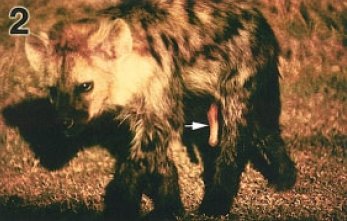
It has long been noted that female hyaenas have very unusual genitalia with the females having an enormously enlarged clitoris giving the appearance of having male genitalia. They even have pseudo testes increasing the resemblance (2).
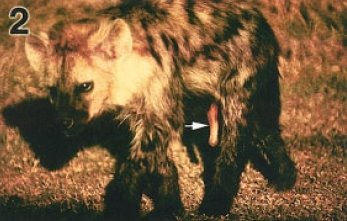
A female hyaena with a arrow pointing to the peniform clitoris

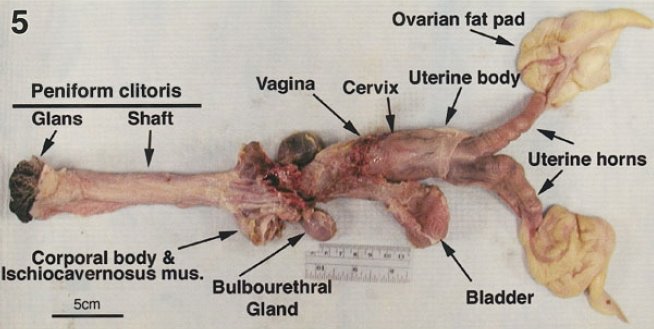
This structure is referred to as the ‘peniform clitoris’ :
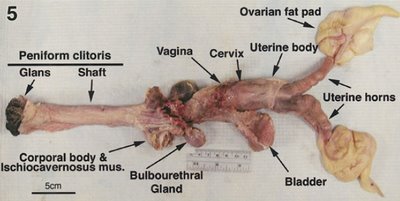
The dissected reproductive organs of a hyaena

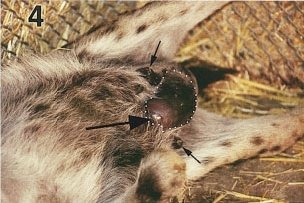
This would appear to be a complete mystery as this imposes a variety of costs throughout life. It makes copulation extremely difficult as intromission has to occur into the enlarged clitoris (!) if mating is difficult that is nothing to giving birth:
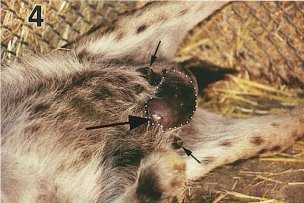
“Toward the end of an extended period of labor, a fetal hyena fills and stretches the clitoris (outlined by white dots) of a primiparous female. The clitoral meatus (large arrow) will eventually tear and permit birth to occur. Subsequent deliveries, through the stretched and torn clitoral meatus, are much more rapid. Note nipples (small arrows).” (2)

At least thing get slightly better with further births although I shouldn’t imagine that is much consolation for the hyaena. In fact, about 60% of first births are stillborn in a captive colony due to this peculiar anatomy; in the wild it could be even higher.

There seems to be two different processes that give rise to the female morphology. The development of the peniform clitoris begins early in development before the late burst of androgens. This shows that it is not a side effect of dominance conferring androgens. It seems like this particular avenue of development has been selected for because it is beneficial in itself. Although high levels of androgens are necessary for the complete development of the peniform clitoris (3) so there is probably some sort of co-evolution.

If there are such heavy costs of this morphology then why does it exist? There are several theories, it is probably partly to do with the increased dominance, aggression and possibly other thing like increased size/muscle mass. But there could be increased dominance without the peniform clitoris so it is likely that it has a benefit in itself, this could be because there is a lot of aggression towards young female hyaenas from siblings adult females and members of other clans and the enlarged clitoris could act to fool other hyaenas into not harming the young females (4).

Refs:

1) S. M. Dloniak, J. A. French and K. E. Holekamp
Rank-related maternal effects of androgens on behaviour in wild spotted hyaenas
Nature 440, 1190-1193 (27 April 2006
) doi:10.1038/nature04540

2) Cunha GR, Wang YZ Place NJ, Liu W, Baskin L, and Glickman SE. (2003). The urogenital system of the female spotted hyena ( Crocuta crocuta ): a functional histological study.
J Morph 256:205–218. (PDF)

3) Cunha GR, Place NJ, Baskin LS, Conley AJ, Weldele ML. Cunha TJ, Wang YZ, Cao M, and Glickman SE. (2005). The ontogeny of the urogenital system of the spotted hyena (Crocuta crocuta Erxleben).
Biol Reprod 73:554-564. (PDF)

4) Muller MN & RW Wrangham.
Sexual mimicry in hyenas.
Quarterly Review of Biology. 77:3-16. (PDF)

Wednesday, April 26, 2006

Vindolanda tablets online


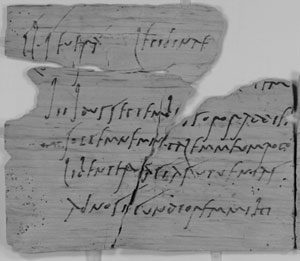
The famous birthday party initation from Claudia Severa to Lepidina
Link

Just found this via ABZU: Vindolanda tablets online, This is a collection of the texts found on wooden tablets at the vindolanda roman fort on hadrian's wall. These have been voted the greatest archaeological treasure in britain, with some justification - they give such rare and amazing details of the people of roman britain. There is all the information you could possibly want - images of the tablets, the latin text, a translation and notes. A treasure trove of information and a great example of providing public access to data.

Chernobyl: 20 years on

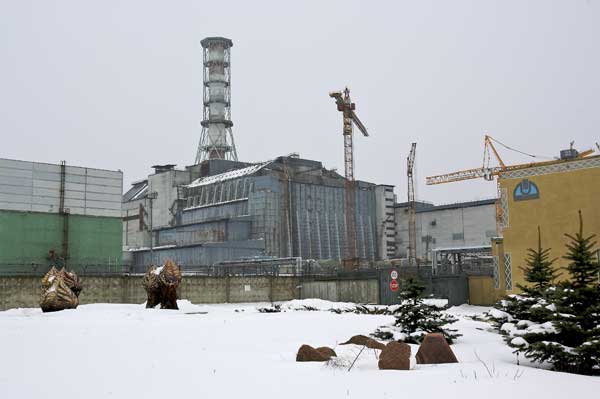
The Chernobyl reactor today, from Daniel Cuthbert

Today is the 20th anniversary of the Chernobyl disaster . There is alot of research on the consequences of this disaster . The health consequnces to people are well known although there is some controversy about the magnitude of these effects but there is also research on the effects on wildlife. The animals did not have the opportunity to flee so provide a fascinating place to study the effects of radiation on various organisms. Tim Mousseau’s Lab has lots of information about Chernobyl and several interesting papers to download:

Biological consequences of Chernobyl: 20 years after the disaster (PDF) - an excellent recent review.

Albinism and phenotype of barn swallows Hirundo rustica from Chernobyl (PDF)

Mutation and sexual selection: A test using barn swallows from Chernobyl (PDF)

Condition, reproduction and survival of barn swallows from Chernobyl (PDF)

See also:

In Focus : Chernobyl (IAEA)

Chernobyl's continuing hazards (BBC)

The Chernobyl disaster (BBC)

Chernobyl's lost city, Daniel Cuthbert, the abandoned city of Pripyat, Ghost Town, (photos)

Sunday, April 23, 2006

Pygmy Elephantids


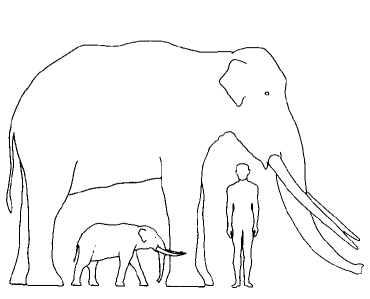
Illustration showing the size of a dwarf elephant

It seems to be common theme that when populations of large mammals are isolated on islands they tend to evolve a dwarfed stature. This is particularly noticeable in elephantids where many have been among the largest species of land animal.

This Island dwarfing has occurred several times in many places and with many different elephantid species, including mammoths on Californian islands, on Wrangel Island in Russia and on the islands of the Mediterranean.

The islands of the Mediterranean have been searched for these the animals and remains have been found on many islands: Sardinia, Sicily, Malta and the Egad Islands, Crete, Cyclades, Dodecanese, Cyprus. They were clearly fairly common in the Mediterranean.

They roamed these islands from the middle Pleistocene (approx ) to about 10,000 years ago. Some people have suggested that they survived into historic times and were depicted on the walls of Egyptian tombs. Sadly, they are all extinct now. One important feature of these elephants is their cuteness. Judging by how many times this dwarfing has happened it shouldn’t be too hard to recreate, a worthy project for someone. I wonder if anyone could get funding for such a project.

There is a theory that the discovery of skulls of pygmy elephants led to the legend of the Cyclops as the skulls have a large hole in the middle (associated with the trunk) that looks a bit like a single large eye socket. The geography origin of the story and occurrence of the pygmies certainly coincide making this theory plausible.

It used to be thought that all of these species were quite closely related and descendants of Elephas antiquus although the polygenetic position derived from their morphology was never particularly clear. There has now been DNA analysis carried out on bones from several different islands and it turns out that these elephantids probably have at least two separate ancestoral species with the eastern and western parts of the Mediterranean being colonized at different times. The ones in the eastern Mediterranean seem to be descended chiefly from Elephas during the Late Pleistocene and those in the eastern from Mammuthus during the Middle Pleistocene.

This research is remarkable because some of the DNA recovered is around 800,000 years old. This represents one of the oldest DNA fragments ever recovered, this opens up the possibility of further analysis of other organisms of this age.

Refs:

Ancient DNA forces reconsideration of evolutionary history of Mediterranean pygmy elephantids.
Biology letters, in press, published online: 21 April, 2006. DOI: 10.1098/rsbl.2006.0467
Nikos Poulakakis, Aris Parmakelis, Petros Lymberakis, et al.

Dwarf elephants (Wikipedia)


Adalgisa Caccone lab

Dwarf elephants: evolutionary patterns (12 papers can be downloaded here)

Cyclops Myth Spurred by "One-Eyed" Fossils?

Did endemic dwarf elephants survive on Mediterranean islands up to protohistorical times? (PDF)

Thursday, April 20, 2006

Pro research petition

Some good news from the BBC:

"An online petition has been launched allowing the UK public to back medical research using animals.

The Coalition for Medical Progress, which includes drug companies and research agencies, started it at the suggestion of a member of the public.

It says the petition will give voice to the "silent majority" who accept the need for animal studies. "

Here it is: http://www.peoplespetition.org.uk/

See also: Pro-test

The Research Defence Society

Wednesday, April 19, 2006

Friday, April 14, 2006

Plant Cellular Anatomy

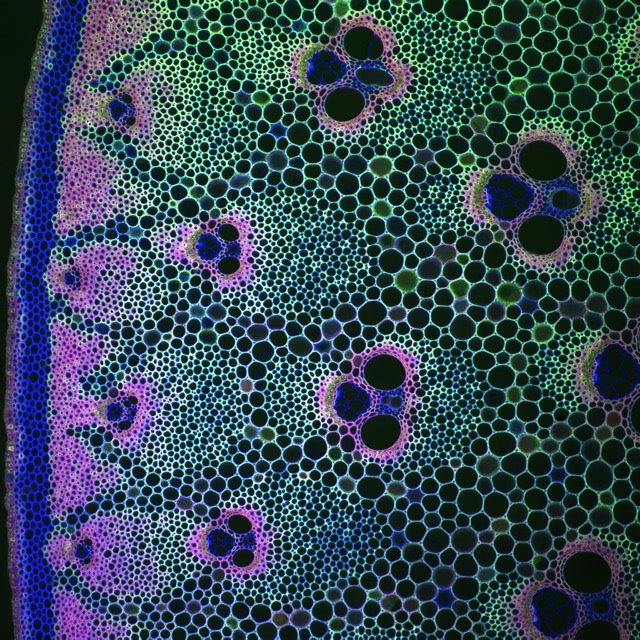
Found via Pruned beautiful pictures of fluorescent stained plant cells, more pictures can be found Here , part of Jim Haseloff's Laboratory website - lots of other interesting stuff there too.

Positive selection on gene expression in the human brain

There has been a fair bit of recent research on the role of positive selection on the evolution of the human brain with the discovery that genes such as FOXP2, ASPM and Microcephalin had undergone rapid evolution on the lineage leading to humans.

A new piece is added to this picture with the publication of a new paper in Current Biology on the evolution of gene expression (1) rather than changes in protein sequence, although the two are not mutually exclusive.

This research compared the amount of linkage disequilibrium (LD) which is expected to be high around genes that have experienced recent positive selection with the amount of expression divergence in four tissues (brain, heart, kidney and liver). There was found to be a positive correlation between LD and genes expression divergence in the brain but no the other three tissues. This indicates that the divergence in gene expression is most likely partly due to positive selection rather than another factor like the relaxation of selective constraint. These results show once again that the human brain which is arguably on of our most unique characteristics is clearly the product of evolution.

Other results include:

"Interestingly, the top 5% of gene orthology groups with the highest expression divergence as well as the highest LD contain many genes involved in metabolism (Supplemental data). These genes, most noticeably the ones involved in electron transport and energy pathways, increased significantly in expression in the human versus the chimpanzee brain. It has been argued that amino acid changes in proteins involved in these pathways might have been positively selected for, due to changes in brain size and lifespan."

"Because we observe correlation between LD and expression changes at the level of functional groups rather than individual genes, some or many of the expression changes selected for in the human lineage may have occurred more than to 200,000 years ago. Consequently, our results do not show that all of the expression changes in brain observed in the human lineage can be explained by events within the last 200,000 years. However, a detectable proportion of these events is recent and potentially associated with the origin of modern humans prior to their spread out of Africa."

This seems to agree with other recent research that there has been alot of selection acting on many genes in the human genome 10,000–40,000 years ago (2) and more recently (3). This type of research has the potential to reveal alot about the genetic basis of humanness and proces of human evolution, although as always there is plenty more to discover.

Refs:
1) Positive selection on gene expression in the human brain
Philipp Khaitovich, Kun Tang, Henriette Franz, Janet Kelso, Ines Hellmann, Wolfgang Enard, Michael Lachmann, and Svante Pääbo. Current biology (in press)
(LINK) full text seems to be available for free at the moment


2) Wang ET, Kodama G, Baldi P, Moyzis RK.
Proc Natl Acad Sci U S A. 2006 Jan 3;103(1):135-40. Epub 2005 Dec 21.
Global landscape of recent inferred Darwinian selection for Homo sapiens.
(LINK)

3) Voight BF, Kudaravalli S, Wen X, Pritchard JK.
PLoS Biol. 2006 Mar;4(3):e72. Epub 2006 Mar 7.
A map of recent positive selection in the human genome.
(LINK)

Sunday, April 09, 2006

More Sharovipteryx

The Hairy Museum of Natural History has a nice post on Sharovipteryx mirabilis with some more information and an excellent drawing of the beast in flight.

Friday, April 07, 2006

Sauropod tracks

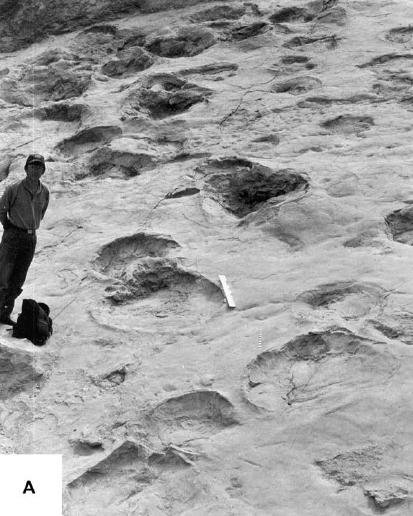
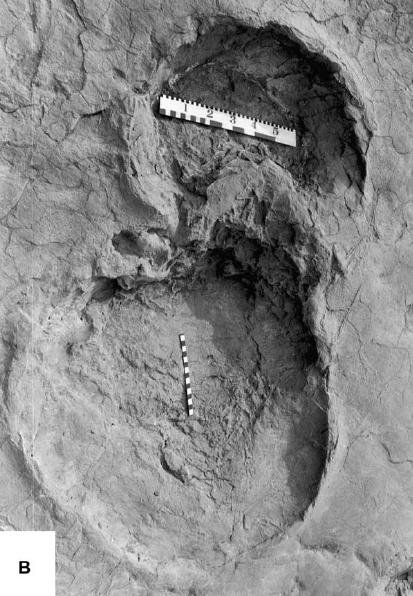
I love these dinosaur tracks, it looks almost as if the giant sauropods had just walked past:


Detail of Sauropod tracks, Large scale bar 50 cm, small scale bar, 20 cm.Plan of the tracks. theropod (white arrows, T1-6), sauropod (black arrows, S1-5), and pterosaur (stippled arrows, P).

Diverse dinosaur-, pterosaur-, and bird-track assemblages from the Hakou Formation, Lower Cretaceous of Gansu Province, northwest China
Jianping Zhang, Daqing Lib, Minglu Li, Martin G. Lockley, Z. Bai.
Cretaceous Research
Volume 27, Issue 1 , February 2006, Pages 44-55
http://dx.doi.org/10.1016/j.cretres.2005.10.006 (free full text as part of sample issue - lots of other interesting stuff)

DNA sequencing revolution?

This press releass via Eurekalert:

Nanopore method could revolutionize genome sequencing

"A team led by physicists at the University of California, San Diego has shown the feasibility of a fast, inexpensive technique to sequence DNA as it passes through tiny pores. The advance brings personalized, genome-based medicine closer to reality.

The paper, published in the April issue of the journal Nano Letters, describes a method to sequence a human genome in a matter of hours at a potentially low cost, by measuring the electrical perturbations generated by a single strand of DNA as it passes through a pore more than a thousand times smaller than the diameter of a human hair. Because sequencing a person's genome would take several months and millions of dollars with current DNA sequencing technology, the researchers say that the new method has the potential to usher in a revolution in medicine."

This is really interesting research, lets hope it can be implemented effectively and cheap genomes become a reality.

Fast DNA Sequencing via Transverse Electronic Transport
Johan Lagerqvist, Michael Zwolak, and Massimiliano Di Ventra
Nano Letters.

Full text Here

Thursday, April 06, 2006

The end of light pollution?

Well hopefully the beginning of the end, here in Britain at least.

New rules have been introduced today which amoung other things will hopefully help reduce light pollution. The 'Clean Neighbourhoods and Environment Act 2005' will bring in fines of up to £5000 for individuals and £20,000 for businesses for light that is 'prejudicial to health or a nuisance'.

It would be amazing if this would lead to me getting to see anything other than the brightest stars and planets.

International Dark-Sky Association
Light pollution soon to be criminal

Wednesday, April 05, 2006

New fossil between fish and tetrapods


A fantastic new fossil documenting the evolutionary transition of vertebrates from the sea to the land has been published in the current issue of nature. It's been called Tiktaalik roseae and seems to be a very important fossil.

There are posts about it in greater detail on Pharyngula , The Lancelet , The Loom , Palaeoblog and The Hairy Museum of Natural History .

The fungi from space

"Swift as the shooting star, that gilds the night
With rapid transient Blaze, she runs, she flies;
Sudden she stops nor longer can endure
The painful course, but drooping sinks away,
And like that falling Meteor, there she lyes
A jelly cold on earth" - William Somerville.

While browsing the Mycologist I found this interesting article on the old idea that fungi came from space and some meteorites contained fungi. This is in some ways logical, fungi often appear very suddenly almost as if they fell from the sky and various fungi can resemble genuine meteorites:

A meteorite

A fungus

Strangely this idea seems to have been resurrected in the age of UFOs where fungi and fairy ring are again mistaken for extra-terrestrial traces.

There are various names for these celestial fungi including ‘star jelly’, ‘rot of the stars’ or ‘star shot’ and ‘pwdre ser’ in welsh. These probably refer to fungi such as Tremella lutescens.

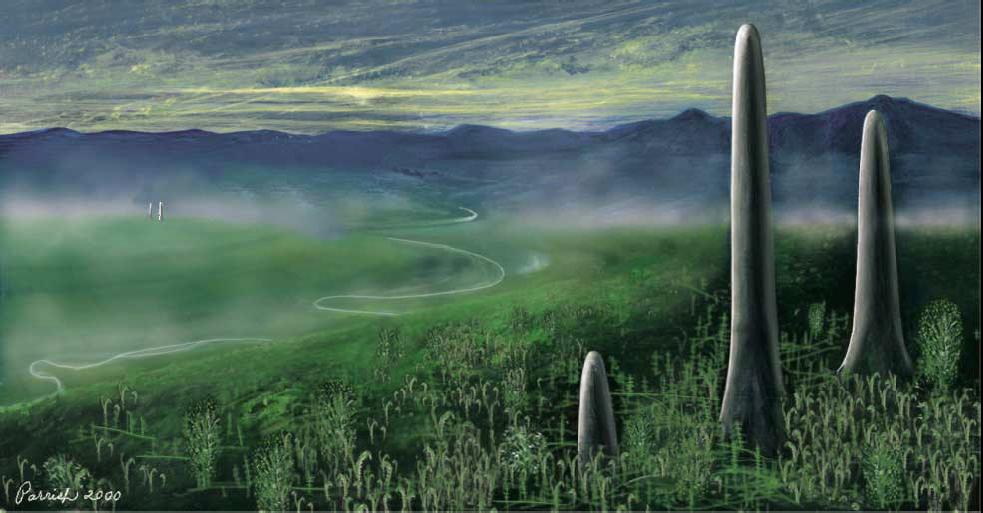
The Idea of space fungi put me in mind of HP lovecraft’s ‘fungi from yuggoth’ and also this illustration of the peculiar ancient fungus Prototaxites:

Prototaxites - Click for larger version

This painting is very evocative of an alien world which in many ways the Devonian was. Its strange how the ancient world can look stranger than people’s imaginary concepts of alien worlds.

Refs:

Ethnomycological notes. II. Meteorites and fungus lore
Mycologist, Volume 20, Issue 1 , February 2006, Pages 22-25
Á.M. Nieves-Rivera and D.A. White.
http://dx.doi.org/10.1016/j.mycol.2005.11.009 (free full text)

Star jelly - Wikipedia

Pwdre Ser or 'Star Jelly' - The Edinburgh Geologist

Pwdre Ser - Space Blobs

Rotted wood–alga–fungus: the history and life of Prototaxites Dawson 1859
Review of Palaeobotany and Palynology
Volume 116, Issues 1-2 , August 2001, Pages 123-158
Francis M. Hueber
http://dx.doi.org/10.1016/S0034-6667(01)00058-6

Tuesday, April 04, 2006

Fake eggs in China!

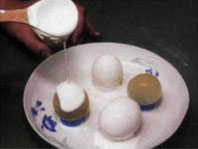
This is totally unbelievable but apparently the notorious fakers of China are no longer content just to pirate medicines, cars, aircraft parts and designer goods and are now creating artificial eggs that they can sell for half the price of real eggs [Via].

These eggs can cause serious health problems if you eat them as they are made from things like Alum, Calcium chloride paraffin wax, gelatine, lactone, carboxymethyl cellulose, sodium alga acid, sodium benzoate, lysine etc. - yuk.

A photo of the final stage in the process of making fake eggs, from Here

See also:

Faked Eggs The World's Most Unbelievable Invention (The Internet Journal of Toxicology)

Egg Piracy in China

http://news.xinhuanet.com/photo/2004-12/28/content_2387255.htm (news report in chinese - pics of real and fake eggs)