I just caught part of a lame BBC programme called 'The Heaven & Earth Show' about scientology Which reminded me just how stoopid this lame cult is. It is incredible that people still believe this rubbish when it is absolutely clear it is complete nonsense, it illuminates an interesting aspect of religious psycology where people refuse to accept any evidence that their faith is false.
I keep getting bothered in Birmingham by scientologists offering to give 'stress test' without of course mentioning that they are scientologists - why are they afraid of being honest about who they are? This constant bothering also seems a bit desperate, lets hope it is because they are short of victims.
"Writing for a penny a word is ridiculous. If a man really wants to make a million dollars, the best way would be to start his own religion." - L. Ron Hubbard founder of scientology
Sunday, January 29, 2006

Friday, January 27, 2006
'The life expectancies of books'
At making light there is an interesting article on why extended copyright on books is a bad idea:
http://nielsenhayden.com/makinglight/archives/007181.html
http://nielsenhayden.com/makinglight/archives/007181.html
Thursday, January 26, 2006
'Children are less able than they used to be'
In the 'Education Guardian' There is a report on research carried out by professor Michael Shayer of King's College London. It is claimed that research shows that:
"11- and 12-year-old children in year 7 are "now on average between two and three years behind where they were 15 years ago", in terms of cognitive and conceptual development."
And what of the cause?
" I would suggest that the most likely reasons are the lack of experiential play in primary schools, and the growth of a video-game, TV culture. Both take away the kind of hands-on play that allows kids to experience how the world works in practice and to make informed judgments about abstract concepts."
This certainly would make sense if reports that television in particular are linked to poor educational outcomes (1) and 'modest adverse effects' on cognition of TV viewing particularly by the under 3s (2) are true.
It is certainly part of the thesis of Dr Aric Sigman in his new book 'Remotely Controlled' which contains some interesting ideas.
'Children are less able than they used to be' http://education.guardian.co.uk/schools/story/0,,1693061,00.html
The Armoured Snail

The as yet un named “scaly foot” gastropod is undoubtedly one of the coolest organisms to be discovered in recent years (1). It’s truly remarkable feature is that the exposed parts of it’s body are covered with overlapping scales of iron sulphide that look for all the world like armour. New research about how this remarkable feature is made has just appeared in ‘Earth and Planetary Science Letters’ (2).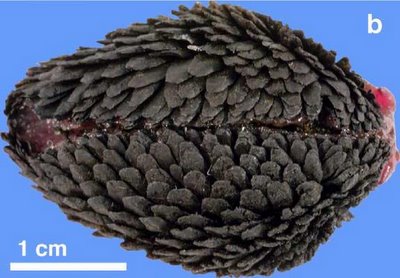
It was previously thought that the iron sulphide could be derived from symbiotic bacteria that are associated with the scales (3). This does not seem to be the case as the isotopic composition of the scales resembles that of the vent fluids and not bacterial metabolites. But it does seem that the control of iron sulphides in cells by this snail which was probably a necessary precursor to the ‘armour’ is related to symbiosis with the bacteria that provide the gastropod with food. These bacteria live inside the esophageal glands (3) and seem to provide the snail with all of it’s nutrition as it has an atrophied gut. The bacteria convert sulphides into compounds that the bacteria and snail can use so it is likely that the snail can regulate intracellular sulphides. It is suggested that it is this adaptation that provided the precursor to ‘snail armour’. Unsurprisingly the researchers also conclude that the function of these scales is for defense possibly against brachyuran crabs.
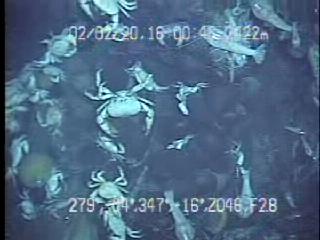 The snail's home at the base of a vent, showing crabs and shrimp.
There is still much to find out about this snail. For example it is not known exactly how the snail controls the iron sulphides what genes are involved in this process and how it is regulated, hopefully further research will reveal more about this incredible creature.
1) A Hot-Vent Gastropod with Iron Sulfide Dermal Sclerites. Science 7 November 2003: Vol. 302. no. 5647, p. 1007 DOI: 10.1126/science.1087696. http://www.marinegeo.uni-bremen.de/pub/pdf/PDF-Datein/2003/Waren_2003_a.pdf
2) Suzuki, Y., Kopp, R.E., Kogure, T., Suga, A., Takai, K., Tsuchida, S., Ozaki, N., Endo, K., Hashimoto, J., Kato, Y., Mizota, C., Hirata, T., Chiba, H., Nealson, K.H., Horikoshi, K., & Kirschvink, J.L.
Sclerite formation in the hydrothermal-vent "scaly-foot" gastropod—possible control of iron sulfide biomineralization by the animal. Earth and Planetary Science Letters 242, 39-50. http://dx.doi.org/10.1016/j.epsl.2005.11.029
Free Full text: PDF
3) Novel Forms of Structural Integration between Microbes and a Hydrothermal Vent Gastropod from the Indian Ocean. Shana K. Goffredi, Anders Warén, Victoria J. Orphan, Cindy L. Van Dover, and Robert C. Vrijenhoek. Applied and Environmental Microbiology, May 2004, p. 3082-3090, Vol. 70, No. 5. http://aem.asm.org/cgi/content/full/70/5/3082
Wednesday, January 25, 2006
The smallest vertebrate
 Some mature members of this species are only 7.9 mm long, aww. But it is depressingly inevitable that their habitat in Southeast asia is threatened so they might not be around for much longer.
Paedocypris, a new genus of Southeast Asian cyprinid fish with a remarkable sexual dimorphism, comprises the world’s smallest vertebrate. Proceedings: Biological Sciences. In press. http://www.journals.royalsoc.ac.uk/link.asp?id=y0g7834174u82404 (featured article available free for a limited period)
Wednesday, January 11, 2006
Friday, January 06, 2006
Balblair rock art update

I have mentioned the rock art at Balblair previously, so its nice to see there is an article on the site in Past the newsletter of the prehistoric society which includes the nice drawings of the art (see above)
http://www.ucl.ac.uk/prehistoric/past/past51.html Which also includes a nice article on loughcrew megalithic cemetary.

Wednesday, December 21, 2005
Old Herbals

Old Herbals are just fantastic, they contain so much interesting historical and medical information about plants. I particularly like 'The Herball' by John Gerarde. It has now been scanned and made available at the amazing Kurt Stüber's Online Library:
http://caliban.mpiz-koeln.mpg.de/~stueber/gerarde/index.html
A new herbal, or historie of plants (1619) by Henry Lyte is also available:
http://caliban.mpiz-koeln.mpg.de/~stueber/lyte/index.html
It’s well worth browsing the online library which contains a huge variety of mostly science related books on everything from botany to geology and mycology. Particularly recommended is "Die Radiolarien Tafeln" and "Kunstformen der Natur" by Ernst Haeckel.
Sunday, December 11, 2005
Tawaraya Sotatsu

Tawaraya Sotatsu (17th century died 1643) is in my opinion one of the great artists of the world and above is a small section of a folding screen produced by him. The image comes from the Tokyo national museum which is a shining example of providing worldwide access via the interent to high quality pictures of it's collection. Compared to the pathetic efforts of british museums it is amazing.
If you want to download a larger version of the above picture of get your hands on other pictures of the screen go to: http://www.tnm.go.jp/jp/gallery/material/film/index.html
and in the lowest section of the search form (フィルム番号 in japanese) there are two boxes with C in from of them. In the left hand box type: 0028941 and then press the search button (containing red text). That should take you to a results page and clicking the top link will take you to the above image.
If you want to search for the artist return to the search page and copy and paste this: 俵屋宗達
into the third box from the top (labelled 作者). The best images of the screen start at C28931.
needless to say Sotatsu is not the only artist in the collection try searching for:
ogata korin: 尾形光琳
hasegawa: 長谷
koetsu: 光悦
liang: 梁
Tosa mitsunobu: 土佐光信
kuniyoshi: 国芳
Suzuki Kiitsu: 鈴木其一
Some Sotatsu links:
http://www.clevelandart.org/Explore/artist.asp?artistLetter=S&recNo=218
http://www.metmuseum.org/toah/ho/09/eaj/ho_1975.268.59.htm
http://www.japanese-arts.net/painting/schools_rinpa_sotatsu.htm
Thursday, December 08, 2005
Mayan codices
 An image from the Kingsborough edition of the Dresden codex that seems to represent a god formed from a mixture of various deities
I have been interested in the mayan civilisation for a long time so I was very happy to discover that FAMSI has made copies of all the mayan codices available to download:
The Dresden Codex
The Grolier Codex
The Madrid Codex
The Paris Codex
They are available to view online of download as PDFs which are up to 90 megs!
The Dresden Codex
The Grolier Codex
The Madrid Codex
The Paris Codex
They are available to view online of download as PDFs which are up to 90 megs!
The magnitude of the destruction of mayan culture that followed the spanish invasion can be appreciated by the fact that these are the only four mayan codices in existance (although one must always hope that some more have been miraculously preserved)
There are also Aztec and Mixtec codices available (mostly just as images online) see complete list: http://www.famsi.org/research/graz/
Sunday, December 04, 2005
Interesting stuff in the Journal of Anatomy
The current issue of the Journal of Anatomy (November 2005) has a whole load of interesting papers. And best of all it is a free sample issue so everyone has access to the articles. My picks are:
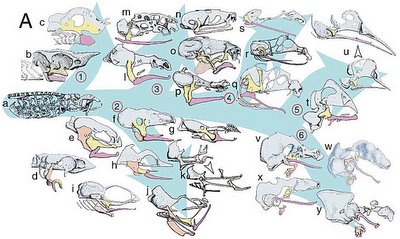
- Evolution of cranial development and the role of neural crest: insights from amphibians
- Developmental studies of the lamprey and hierarchical evolutionary steps towards the acquisition of the jaw
- Reassessing the Dlx code: the genetic regulation of branchial arch skeletal pattern and development
- mechanisms facilitating the evolution of bills and quills
- Deer antlers: a zoological curiosity or the key to understanding organ regeneration in mammals?
"Schemae of gnathostome chondrocrania demonstrating the conservation of an ordered series of splanchnocranial elements in the gnathostome bauplan. Maxillary arch derivatives are depicted in yellow,mandibular arch in lavender and caudal arches in salmon and/or white. The neurocranial chondrocranium is in light blue. " from 'Reassessing the Dlx code', for full label see the original article.
Sunday, November 27, 2005
Carbon dioxide level highest in 650,000 years
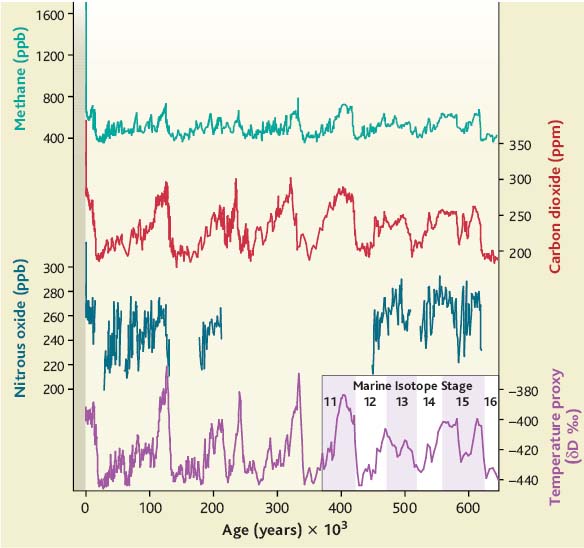
Refs: Spahni, R., J. Chappellaz, T.F. Stocker, L. Loulergue, G. Hausammann, K. Kawamura, J. Flückiger, J. Schwander, D. Raynaud, V. Masson-Delmotte, J. Jouzel, Atmospheric methane and nitrous oxide of the late Pleistocene from Antarctic ice cores, 310, Science, 1317-1321, 2005.
http://spot.colorado.edu/~flueckig/publications.html
Siegenthaler, U. T.F. Stocker, E. Monnin, D. Lüthi, J. Schwander, B. Stauffer, D. Raynaud, J.-M. Barnola, H. Fischer, V. Masson-Delmotte, J. Jouzel, 2005, Stable carbon cycle-climate relationship during the late Pleistocene. Science 310, 1313-1317.
http://www.climate.unibe.ch/~stocker/publications.html
Saturday, November 05, 2005
MRSA And Bad Reporting
The latest saga of the dodgy MRSA lab is available from bad science:
Microbiologists raising doubts? It must be a cover-up
This story really does illustrate how dishonest tabloid reporting is here in the UK (guilty papers: Sun, Mirror, Mail, Evening Standard and more) Reporters seem to think it is OK to essentially fabricate evidence of MRSA contamination and then sling allegations of a 'cover-up' around when their dishonesty is exposed.
Other posts on this story:
After feeding the scare he’ll sell you the solution
The man behind the Mop of Death
Lab that finds bugs where others do not
Microbiologists raising doubts? It must be a cover-up
This story really does illustrate how dishonest tabloid reporting is here in the UK (guilty papers: Sun, Mirror, Mail, Evening Standard and more) Reporters seem to think it is OK to essentially fabricate evidence of MRSA contamination and then sling allegations of a 'cover-up' around when their dishonesty is exposed.
Other posts on this story:
After feeding the scare he’ll sell you the solution
The man behind the Mop of Death
Lab that finds bugs where others do not
New Brain Atlas
I have just found this site via neurodudes and it looks pretty neat:
http://brainmaps.org/index.php
It is still in development so it should get even better in the future!
If you like brains, see also: The Brain Museum
"BrainMaps.org is an interactive high-resolution digital brain atlas and virtual microscope that is based on scanned images of serial sections of both primate and non-primate brains and that is fully integrated with a high-speed database server for querying and retrieving data about brain structure and function over the internet"
http://brainmaps.org/index.php
It is still in development so it should get even better in the future!
If you like brains, see also: The Brain Museum
New Dmanisi paper
 Dmanisi Skull D2282
 Dmanisi in Georgia is a very important site in the understanding of human evolution so it is nice to see that a new paper on these finds is soon to be published in the journal of human evolution. The bones in this site are very well preserved so reveal alot of information about our ancestors. Dmanisi hominins are probably some of the earliest human ancestors to venture out of Africa - possibly due to greater intelligence enabling exploitation of new environments.
To get to Georgia the Dmanisi hominins must have travelled through Turkey - i wonder if there are more fossils of this age still to be found in this part of the world?
Anatomical descriptions, comparative studies and evolutionarysignificance of the hominin skulls from Dmanisi, Republic of Georgia
Philip Rightmire, David Lordkipanidze, Abesalom Vekua
Journal of human evolution - in press
Abstract: Evidence for ancient hominin occupation in Eurasia comes from Dmanisi in the Georgian Caucasus. Stratigraphic and sedimentological arguments,geochemical observations, paleomagnetic sampling and radiometric dates all point to the conclusion that bones and artifacts were depositedat this site during a brief interval following the close of the Olduvai Subchron (1.77 million years ago). In this report we presentfurther descriptive and comparative studies of the D2280 braincase, the D2282 partial cranium, now linked with the D211 mandible, and theskull D2700/D2735. The crania have capacities ranging from 600 cm3 to 775 cm3. Supraorbital tori and other vault superstructures are onlymoderately developed. The braincase is expanded laterally in the mastoid region, but the occiput is rounded. The pattern of sagittal keelingis distinctive. D2700 displays a prominent midfacial profile and has a very short nasoalveolar clivus. Also, the M3 crowns are reduced insize. Although there is variation probably related to growth status and sex dimorphism, it is appropriate to group the Dmanisi hominins together.With the possible exception of the large D2600 mandible, the individuals are sampled from one paleodeme. This population resembles Homohabilis in brain volume and some aspects of craniofacial morphology, but many of these features can be interpreted as symplesiomorphies. Otherdiscrete characters and measurements suggest that the Dmanisi skulls are best placed with H. erectus. There are numerous similarities to individualsfrom the Turkana Basin in Kenya, but a few features link Dmanisi to Sangiran in Java. Some traits expressed in the Dmanisi assemblageappear to be unique. Reconstructing the evolutionary relationships of these ancient populations of Africa and Eurasia is difficult, as the record isquite patchy, and determination of character polarities is not straightforward. Nevertheless, the evidence from anatomical analysis and measurementssupports the hypothesis that Dmanisi is close to the stem from which H. erectus evolved.
Some nice pictures of the excavation in progress and people involved: http://www.fas.harvard.edu/~skeleton/pontzerDmanisi.htm
Monday, October 31, 2005
3D scanning of prehistoric art
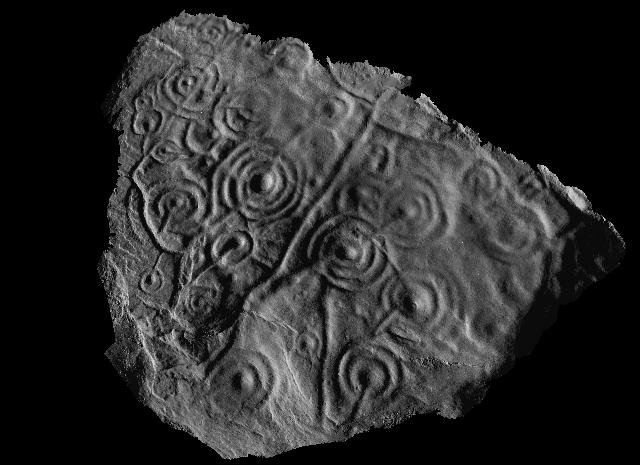
Archaeoptics has just relased the news that they have finished scanning several rock art panels: Ketley Crag, Chatton Park 1, Huntersheugh Howgill and Cotherstone. This is good news as laser scanning is the most accurate and non destructive way of recording rock art and so will provide an excellent record of these carvings many of which are threatened in many different ways.
Link
Beckensall Archive of Northumberland Rock Art
I have also come across a nice article on the scanning of the art at Long Meg: http://www.ucl.ac.uk/prehistoric/past/past50.html#LASERSCANNING
See also: Dr. Margarita Díaz-Andreu
Sunday, October 30, 2005
Brush up on your Yucatec
I was interested to learn that Mel Gibson's new film Apocalypto will be performed in the maya language Yucatec. This has to be a first but it is a good idea as Mayan history contains some brilliant stories, impressive spectacle and loads of violence. In case you wanted to learn more about this language here are some resources:
A Brief Introduction to Yucatec Maya
Combined Dictionary–Concordance of the Yucatecan Mayan Language
an online dictionary of all Mayan languages
Story about the film
A Brief Introduction to Yucatec Maya
Combined Dictionary–Concordance of the Yucatecan Mayan Language
an online dictionary of all Mayan languages
Story about the film
Eastern Zhou grave discovered

The eastern zhou (770-256 BC) has produced some absolutely amazing relics so it’s nice to learn that a new tomb from that era has been discovered near Luoyang and properly excavated rather than being looted.
Link
Saving China's antiquities
Monday, October 24, 2005
New Rock Art
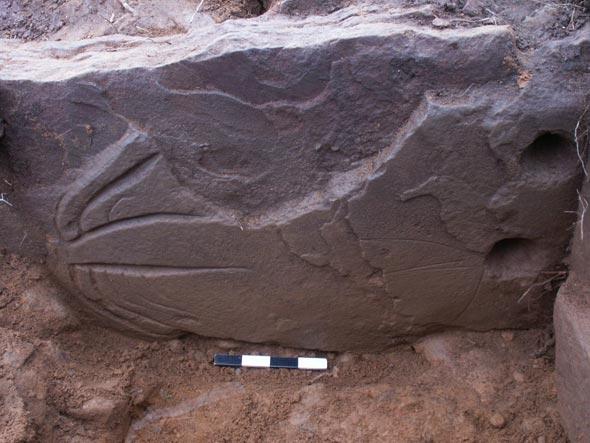 I do love megalithtic art so i was very excited to hear about the discovery of a new decorated tomb in Scotland. The find was at Balblair Quarry, Beauly near Inverness an area that does not contain any similar art. It looks like the sort of thing that is found in Ireland and areas influenced by Ireland so the discovery on the east coast is an enigma. More information on the excavation and further pictures can be found here.
Subscribe to:
Posts (Atom)