Wednesday, April 26, 2006

Chernobyl: 20 years on

The Chernobyl reactor today, from Daniel Cuthbert

Today is the 20th anniversary of the Chernobyl disaster . There is alot of research on the consequences of this disaster . The health consequnces to people are well known although there is some controversy about the magnitude of these effects but there is also research on the effects on wildlife. The animals did not have the opportunity to flee so provide a fascinating place to study the effects of radiation on various organisms. Tim Mousseau’s Lab has lots of information about Chernobyl and several interesting papers to download:

Biological consequences of Chernobyl: 20 years after the disaster (PDF) - an excellent recent review.

Albinism and phenotype of barn swallows Hirundo rustica from Chernobyl (PDF)

Mutation and sexual selection: A test using barn swallows from Chernobyl (PDF)

Condition, reproduction and survival of barn swallows from Chernobyl (PDF)

See also:

In Focus : Chernobyl (IAEA)

Chernobyl's continuing hazards (BBC)

The Chernobyl disaster (BBC)

Chernobyl's lost city, Daniel Cuthbert, the abandoned city of Pripyat, Ghost Town, (photos)

Sunday, April 23, 2006

Pygmy Elephantids


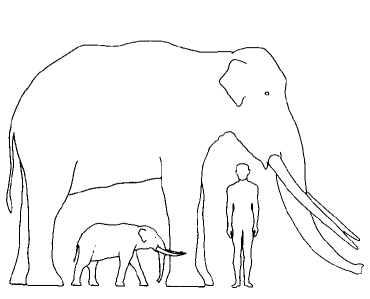
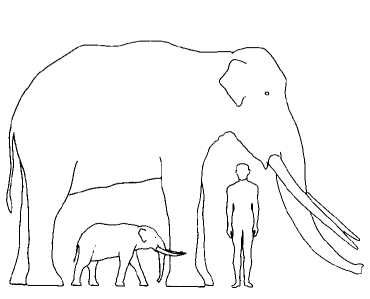
Illustration showing the size of a dwarf elephant

It seems to be common theme that when populations of large mammals are isolated on islands they tend to evolve a dwarfed stature. This is particularly noticeable in elephantids where many have been among the largest species of land animal.

This Island dwarfing has occurred several times in many places and with many different elephantid species, including mammoths on Californian islands, on Wrangel Island in Russia and on the islands of the Mediterranean.

The islands of the Mediterranean have been searched for these the animals and remains have been found on many islands: Sardinia, Sicily, Malta and the Egad Islands, Crete, Cyclades, Dodecanese, Cyprus. They were clearly fairly common in the Mediterranean.

They roamed these islands from the middle Pleistocene (approx ) to about 10,000 years ago. Some people have suggested that they survived into historic times and were depicted on the walls of Egyptian tombs. Sadly, they are all extinct now. One important feature of these elephants is their cuteness. Judging by how many times this dwarfing has happened it shouldn’t be too hard to recreate, a worthy project for someone. I wonder if anyone could get funding for such a project.

There is a theory that the discovery of skulls of pygmy elephants led to the legend of the Cyclops as the skulls have a large hole in the middle (associated with the trunk) that looks a bit like a single large eye socket. The geography origin of the story and occurrence of the pygmies certainly coincide making this theory plausible.

It used to be thought that all of these species were quite closely related and descendants of Elephas antiquus although the polygenetic position derived from their morphology was never particularly clear. There has now been DNA analysis carried out on bones from several different islands and it turns out that these elephantids probably have at least two separate ancestoral species with the eastern and western parts of the Mediterranean being colonized at different times. The ones in the eastern Mediterranean seem to be descended chiefly from Elephas during the Late Pleistocene and those in the eastern from Mammuthus during the Middle Pleistocene.

This research is remarkable because some of the DNA recovered is around 800,000 years old. This represents one of the oldest DNA fragments ever recovered, this opens up the possibility of further analysis of other organisms of this age.

Refs:

Ancient DNA forces reconsideration of evolutionary history of Mediterranean pygmy elephantids.
Biology letters, in press, published online: 21 April, 2006. DOI: 10.1098/rsbl.2006.0467
Nikos Poulakakis, Aris Parmakelis, Petros Lymberakis, et al.

Dwarf elephants (Wikipedia)


Adalgisa Caccone lab

Dwarf elephants: evolutionary patterns (12 papers can be downloaded here)

Cyclops Myth Spurred by "One-Eyed" Fossils?

Did endemic dwarf elephants survive on Mediterranean islands up to protohistorical times? (PDF)

Thursday, April 20, 2006

Pro research petition

Some good news from the BBC:

"An online petition has been launched allowing the UK public to back medical research using animals.

The Coalition for Medical Progress, which includes drug companies and research agencies, started it at the suggestion of a member of the public.

It says the petition will give voice to the "silent majority" who accept the need for animal studies. "

Here it is: http://www.peoplespetition.org.uk/

See also: Pro-test

The Research Defence Society

Wednesday, April 19, 2006

Friday, April 14, 2006

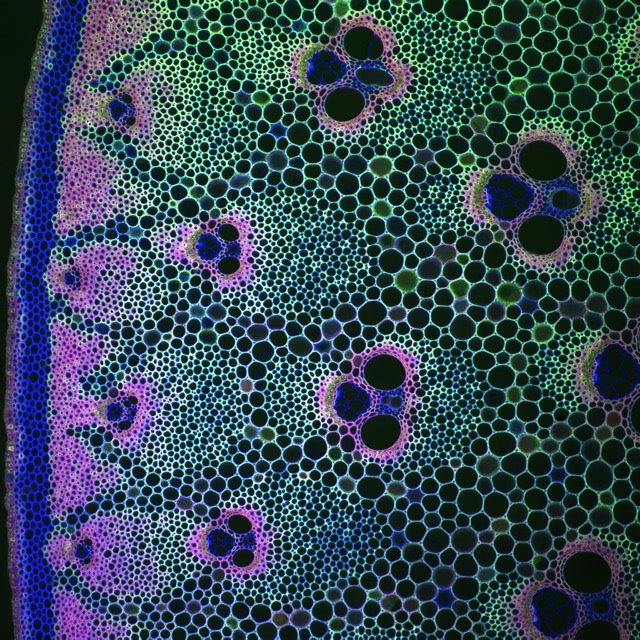
Plant Cellular Anatomy

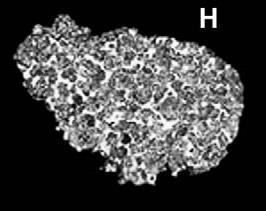
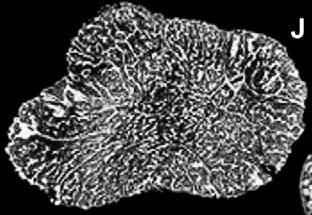
Found via Pruned beautiful pictures of fluorescent stained plant cells, more pictures can be found Here , part of Jim Haseloff's Laboratory website - lots of other interesting stuff there too.

Positive selection on gene expression in the human brain

There has been a fair bit of recent research on the role of positive selection on the evolution of the human brain with the discovery that genes such as FOXP2, ASPM and Microcephalin had undergone rapid evolution on the lineage leading to humans.

A new piece is added to this picture with the publication of a new paper in Current Biology on the evolution of gene expression (1) rather than changes in protein sequence, although the two are not mutually exclusive.

This research compared the amount of linkage disequilibrium (LD) which is expected to be high around genes that have experienced recent positive selection with the amount of expression divergence in four tissues (brain, heart, kidney and liver). There was found to be a positive correlation between LD and genes expression divergence in the brain but no the other three tissues. This indicates that the divergence in gene expression is most likely partly due to positive selection rather than another factor like the relaxation of selective constraint. These results show once again that the human brain which is arguably on of our most unique characteristics is clearly the product of evolution.

Other results include:

"Interestingly, the top 5% of gene orthology groups with the highest expression divergence as well as the highest LD contain many genes involved in metabolism (Supplemental data). These genes, most noticeably the ones involved in electron transport and energy pathways, increased significantly in expression in the human versus the chimpanzee brain. It has been argued that amino acid changes in proteins involved in these pathways might have been positively selected for, due to changes in brain size and lifespan."

"Because we observe correlation between LD and expression changes at the level of functional groups rather than individual genes, some or many of the expression changes selected for in the human lineage may have occurred more than to 200,000 years ago. Consequently, our results do not show that all of the expression changes in brain observed in the human lineage can be explained by events within the last 200,000 years. However, a detectable proportion of these events is recent and potentially associated with the origin of modern humans prior to their spread out of Africa."

This seems to agree with other recent research that there has been alot of selection acting on many genes in the human genome 10,000–40,000 years ago (2) and more recently (3). This type of research has the potential to reveal alot about the genetic basis of humanness and proces of human evolution, although as always there is plenty more to discover.

Refs:
1) Positive selection on gene expression in the human brain
Philipp Khaitovich, Kun Tang, Henriette Franz, Janet Kelso, Ines Hellmann, Wolfgang Enard, Michael Lachmann, and Svante Pääbo. Current biology (in press)
(LINK) full text seems to be available for free at the moment


2) Wang ET, Kodama G, Baldi P, Moyzis RK.
Proc Natl Acad Sci U S A. 2006 Jan 3;103(1):135-40. Epub 2005 Dec 21.
Global landscape of recent inferred Darwinian selection for Homo sapiens.
(LINK)

3) Voight BF, Kudaravalli S, Wen X, Pritchard JK.
PLoS Biol. 2006 Mar;4(3):e72. Epub 2006 Mar 7.
A map of recent positive selection in the human genome.
(LINK)

Sunday, April 09, 2006

More Sharovipteryx

The Hairy Museum of Natural History has a nice post on Sharovipteryx mirabilis with some more information and an excellent drawing of the beast in flight.

Friday, April 07, 2006

Sauropod tracks

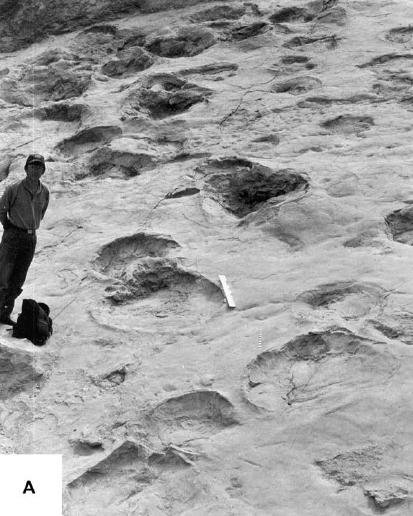
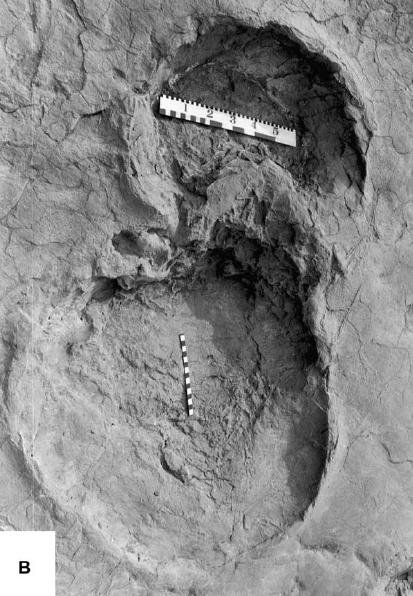
I love these dinosaur tracks, it looks almost as if the giant sauropods had just walked past:


Detail of Sauropod tracks, Large scale bar 50 cm, small scale bar, 20 cm.Plan of the tracks. theropod (white arrows, T1-6), sauropod (black arrows, S1-5), and pterosaur (stippled arrows, P).

Diverse dinosaur-, pterosaur-, and bird-track assemblages from the Hakou Formation, Lower Cretaceous of Gansu Province, northwest China
Jianping Zhang, Daqing Lib, Minglu Li, Martin G. Lockley, Z. Bai.
Cretaceous Research
Volume 27, Issue 1 , February 2006, Pages 44-55
http://dx.doi.org/10.1016/j.cretres.2005.10.006 (free full text as part of sample issue - lots of other interesting stuff)

DNA sequencing revolution?

This press releass via Eurekalert:

Nanopore method could revolutionize genome sequencing

"A team led by physicists at the University of California, San Diego has shown the feasibility of a fast, inexpensive technique to sequence DNA as it passes through tiny pores. The advance brings personalized, genome-based medicine closer to reality.

The paper, published in the April issue of the journal Nano Letters, describes a method to sequence a human genome in a matter of hours at a potentially low cost, by measuring the electrical perturbations generated by a single strand of DNA as it passes through a pore more than a thousand times smaller than the diameter of a human hair. Because sequencing a person's genome would take several months and millions of dollars with current DNA sequencing technology, the researchers say that the new method has the potential to usher in a revolution in medicine."

This is really interesting research, lets hope it can be implemented effectively and cheap genomes become a reality.

Fast DNA Sequencing via Transverse Electronic Transport
Johan Lagerqvist, Michael Zwolak, and Massimiliano Di Ventra
Nano Letters.

Full text Here

Thursday, April 06, 2006

The end of light pollution?

Well hopefully the beginning of the end, here in Britain at least.

New rules have been introduced today which amoung other things will hopefully help reduce light pollution. The 'Clean Neighbourhoods and Environment Act 2005' will bring in fines of up to £5000 for individuals and £20,000 for businesses for light that is 'prejudicial to health or a nuisance'.

It would be amazing if this would lead to me getting to see anything other than the brightest stars and planets.

International Dark-Sky Association
Light pollution soon to be criminal

Wednesday, April 05, 2006

New fossil between fish and tetrapods


A fantastic new fossil documenting the evolutionary transition of vertebrates from the sea to the land has been published in the current issue of nature. It's been called Tiktaalik roseae and seems to be a very important fossil.

There are posts about it in greater detail on Pharyngula , The Lancelet , The Loom , Palaeoblog and The Hairy Museum of Natural History .

The fungi from space

"Swift as the shooting star, that gilds the night
With rapid transient Blaze, she runs, she flies;
Sudden she stops nor longer can endure
The painful course, but drooping sinks away,
And like that falling Meteor, there she lyes
A jelly cold on earth" - William Somerville.

While browsing the Mycologist I found this interesting article on the old idea that fungi came from space and some meteorites contained fungi. This is in some ways logical, fungi often appear very suddenly almost as if they fell from the sky and various fungi can resemble genuine meteorites:

A meteorite

A fungus

Strangely this idea seems to have been resurrected in the age of UFOs where fungi and fairy ring are again mistaken for extra-terrestrial traces.

There are various names for these celestial fungi including ‘star jelly’, ‘rot of the stars’ or ‘star shot’ and ‘pwdre ser’ in welsh. These probably refer to fungi such as Tremella lutescens.

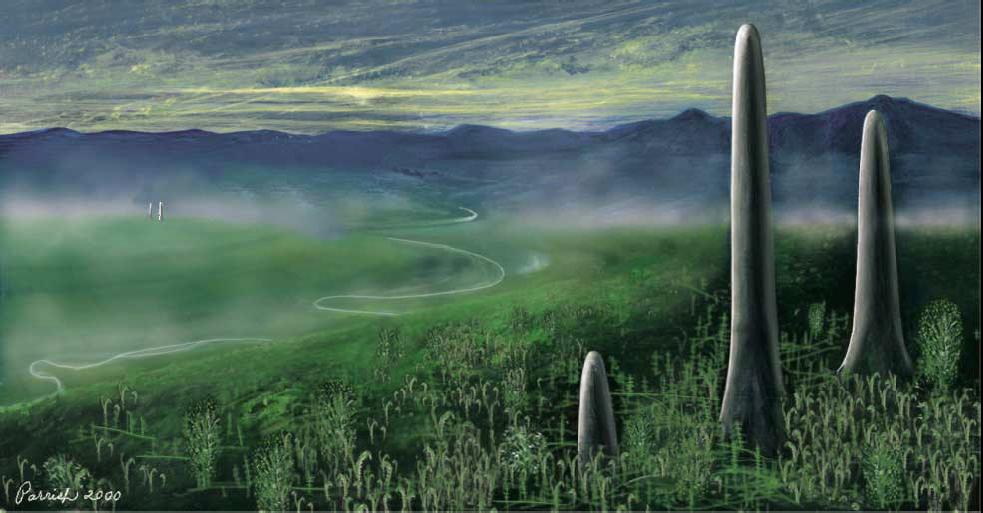
The Idea of space fungi put me in mind of HP lovecraft’s ‘fungi from yuggoth’ and also this illustration of the peculiar ancient fungus Prototaxites:

Prototaxites - Click for larger version

This painting is very evocative of an alien world which in many ways the Devonian was. Its strange how the ancient world can look stranger than people’s imaginary concepts of alien worlds.

Refs:

Ethnomycological notes. II. Meteorites and fungus lore
Mycologist, Volume 20, Issue 1 , February 2006, Pages 22-25
Á.M. Nieves-Rivera and D.A. White.
http://dx.doi.org/10.1016/j.mycol.2005.11.009 (free full text)

Star jelly - Wikipedia

Pwdre Ser or 'Star Jelly' - The Edinburgh Geologist

Pwdre Ser - Space Blobs

Rotted wood–alga–fungus: the history and life of Prototaxites Dawson 1859
Review of Palaeobotany and Palynology
Volume 116, Issues 1-2 , August 2001, Pages 123-158
Francis M. Hueber
http://dx.doi.org/10.1016/S0034-6667(01)00058-6

Tuesday, April 04, 2006

Fake eggs in China!

This is totally unbelievable but apparently the notorious fakers of China are no longer content just to pirate medicines, cars, aircraft parts and designer goods and are now creating artificial eggs that they can sell for half the price of real eggs [Via].

These eggs can cause serious health problems if you eat them as they are made from things like Alum, Calcium chloride paraffin wax, gelatine, lactone, carboxymethyl cellulose, sodium alga acid, sodium benzoate, lysine etc. - yuk.

A photo of the final stage in the process of making fake eggs, from Here

See also:

Faked Eggs The World's Most Unbelievable Invention (The Internet Journal of Toxicology)

Egg Piracy in China

http://news.xinhuanet.com/photo/2004-12/28/content_2387255.htm (news report in chinese - pics of real and fake eggs)

Wednesday, March 29, 2006

Sleep more - weigh less

Well for children anyway:

"The less a child sleeps, the more likely he or she is to become overweight, according to researchers from Université Laval's Faculty of Medicine in an article published in the latest edition of the International Journal of Obesity. The risk of becoming overweight is 3.5 times higher in children who get less sleep than in those who sleep a lot, according to researchers Jean-Philippe Chaput, Marc Brunet, and Angelo Tremblay." [VIA]

There seems to be a direct causal link between short periods of sleep and reduced levels of leptin and higher levels of ghrelin. This seems to cause increased appetite and thus BMI so this association between a lack of sleep and obesity is probably true for everyone.

I suspect a major cause of sleep deprivation in children and adults is excessive television watching and also sadly computer use.


References:

Chaput JP, Brunet M, Tremblay A.Int J Obes (Lond). 2006 Mar 14; [Epub ahead of print]
Relationship between short sleeping hours and childhood overweight/obesity:
results from the 'Quebec en Forme' Project. [LINK]

Taheri S, Lin L, Austin D, Young T, Mignot E.
PLoS Med. 2004 Dec;1(3):e62. Epub 2004 Dec 7.
Short sleep duration is associated with reduced leptin, elevated ghrelin, and
increased body mass index. [LINK - full text]

Friday, March 24, 2006

Glaciers in retreat

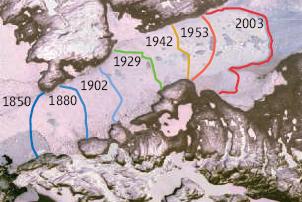
The recent retreat of the Jakobshavn Isbrae glacier in Greenland

Three Papers in the current issue of Science show the rapid changes that are occurring in world's glaciers.

Paleoclimatic Evidence for Future Ice-Sheet Instability and Rapid Sea-Level Rise
Jonathan T. Overpeck, Bette L. Otto-Bliesner, Gifford H. Miller, Daniel R. Muhs, Richard B. Alley, and Jeffrey T. Kiehl
Science 24 March 2006: 1747-1750.

Simulating Arctic Climate Warmth and Icefield Retreat in the Last Interglaciation
Bette L. Otto-Bliesner, Shawn J. Marshall, Jonathan T. Overpeck, Gifford H. Miller, Aixue Hu, and CAPE Last Interglacial Project members
Science 24 March 2006: 1751-1753.

Measurements of Time-Variable Gravity Show Mass Loss in Antarctica
Isabella Velicogna and John Wahr
Science 24 March 2006: 1754-1756.
Published online 2 March 2006 [DOI: 10.1126/science.1123785] (in Science Express Reports)


Press for these papers:
Sea rise could be 'catastrophic' (BBC)
Polar Meltdown Near: Seas Could Rise 3 Feet Per Century (Livescience)

Thursday, March 23, 2006

Ediacaran website

Vendia rachiata (?) which looks a bit like a trilobite but probably isn't

While browsing the internet for information on those strange ediacaran creatures I stumbled upon this russian website: http://vend.paleo.ru/ If you are interested in these mysterious creatures it's worth a look.

Although it is all in russian Babelfish does a fairly decent translation, here is their description of the site:

"Our laboratory is occupied by the complex of the early stages of the evolution of biosphere, which preceded the phanerozoic jump of bioraznoobraziya. Special attention in this case is paid to the vendskomu period as to the period, which completes the Proterozoic stage of the evolution of biosphere. For a long time considered as the almost silent, this section of geological chronicle is at the present time remarkable with this number of surprising findings of the remainders of undoubtedly organic nature, that it is possible to indicate that we already see the letters, which wrote the history of the evolution of the biosphere of that time, but yet we cannot understand entire text, which is collected by these letters. On this site are assembled the meaningful results of the work of our laboratory, materials about the directions of research activity, most significant publications, debatable materials."

Being russian they call this period (from the gaskiers glaciation to the cambrian, 632-542 MYA) the vendian even though the internationally accepted name is now the ediacaran.

There is lots of interesting stuff there, the best stuff is probably a nice selection of papers in english and russian that can be downloaded: http://vend.paleo.ru/pub_ru.php & http://vend.paleo.ru/pub_eng.php. Particularly good is 'Ivantsov Malakhovskaya 2003' which is in russian and has some amazing images of ediacaran fossils.

Their research is mainly conducted on the remarkable fossils found in cliffs by the white sea in russia. Other ediacaran localities are the Ediacra hills Australia, Mistaken point Canada, Charnwood in England and Namibia.


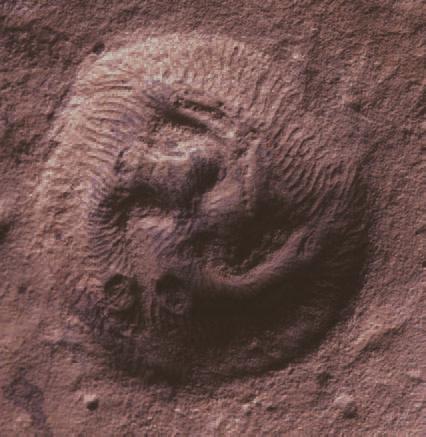
Tribrachidium heraldicum - deeply weird

Tuesday, March 21, 2006

sharovipteryx


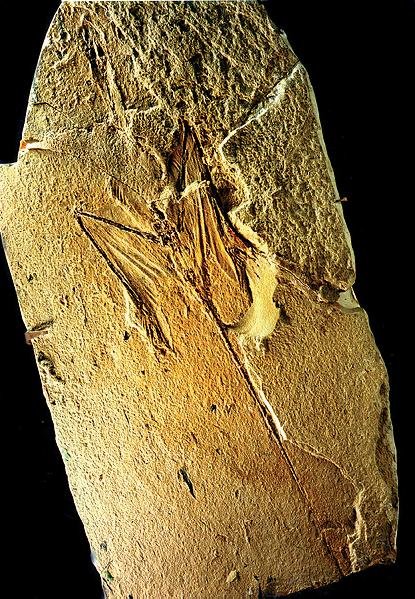
The only fossil specimen of Sharovipteryx mirabilis


Sharovipteryx mirabilis is one of the odder creatures to be found in the fossil record notable because it seems to have wings on it's hind limbs which seems to be a unique adaptation.

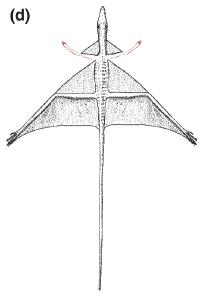
A new paper is in press in the Journal of Evolutionary Biology that proposes a model of how this strange beast would have flown. Their reconstruction is shown below. I have no idea if this is actually what the creature would have looked like but it seems like a fairly logical interpretation of the fossil.
Flight of Sharovipteryx mirabilis: the world’s first delta-winged
glider. G. J. DYKE, R. L. NUDDS & J. M. V. RAYNER. Journal evolutionary biology (in press) doi:10.1111/j.1420-9101.2006.01105.x

Wednesday, March 15, 2006

Frog spawn


The common frog (Rana temporaria) mating and spawning season is in full swing in the garden pond. There is a fairly large amount of spawn this year. Although thats only half the battle, lets hope there isn't another really cold snap so it doesn't all die, and that it stays healthy so there is a nice big crop of froglets this year.

I have a lingering fondness for frogspawn after playing with it when i was young and I still remember being fascinated watching the tadpoles develop. I am sure that is one of the things that made me interested in biology and conservation.

Links:
Declining Amphibians Population Task Force (DAPTF)
herpetofauna
froglife

Monday, March 13, 2006

How to buy fish with a clear conscience

There is a nice article in todays Independent called 'How to buy fish with a clear conscience'

"For years, the unpalatable details of the industry that delivers fish to supermarket shelves have been a well-kept secret, along with the scientific data that shows that some fish are being fished to near-extinction. But not any longer.

The ranks of enlightened fish consumers grow by the day, and proof that some of the supermarkets are waking up to the issue arrived when Greenpeace scaled the Asda headquarters in Leeds in January. No sooner was a banner unfurled from the roof depicting some of the dead and mutilated by-catch, than the campaigners were ushered inside for a chat about the sustainability of the supermarket's fish-buying policies.

Asda, which was rock bottom of a Greenpeace table of supermarkets ranked on their fish-buying policies several months ago, and in the bottom half of a similar Marine Conservation Society (MCS) table published earlier this month, announced immediately that it was removing skate wings, Dover sole, ling and dogfish from its stores. Since Asda's move, Sainsbury's has announced that it will no longer sell skate and huss, both endangered, while in the US, the discount giant Wal-Mart (which owns Asda) has declared that it will buy all of its fresh fish from sustainable sources within three to five years.

.....

Not all fish are so problematic. Lemon sole, red mullet, red gurnard and most salmon are generally acceptable, while Atlantic halibut, skate, swordfish and marlin are not. If a blue certification logo (a fish and a tick) is stamped on a product, it is one of the 50 products accredited by the Marine Stewardship Council, and is sustainable."

Marine conservation is a very important area that is often ignored because of the fishing lobby. This has led to awful mismanagement of fish resources, lets hope that consumer power can change things.

Some resources:

marine conservation society report mentioned in the article: http://www.mcsuk.org/press/press_release.php?cust_id=62

fish online

greenpeace sustainable fish campaign

Marine Stewardship Council

Marine Conservation Biology Institute

save the high seas

What You Can Do to Save the Deep Sea

Monday, March 06, 2006

cool origami


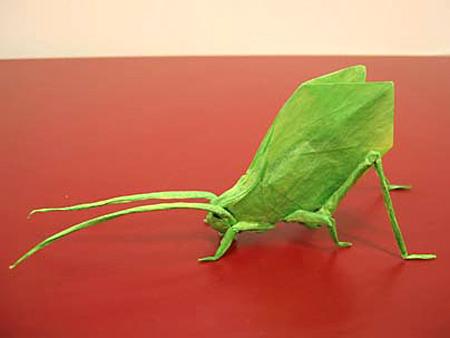
There are some amazing origami design created for ther MIT origami competition (via) Two of the winners are Jason Ku and Brian Chan and several neat designs are available from their websites. The cool Katydid in the picture is by Brian Chan (link) and there are several other nice insect designs available on his website.