Well for children anyway:
"The less a child sleeps, the more likely he or she is to become overweight, according to researchers from Université Laval's Faculty of Medicine in an article published in the latest edition of the International Journal of Obesity. The risk of becoming overweight is 3.5 times higher in children who get less sleep than in those who sleep a lot, according to researchers Jean-Philippe Chaput, Marc Brunet, and Angelo Tremblay." [VIA]
There seems to be a direct causal link between short periods of sleep and reduced levels of leptin and higher levels of ghrelin. This seems to cause increased appetite and thus BMI so this association between a lack of sleep and obesity is probably true for everyone.
I suspect a major cause of sleep deprivation in children and adults is excessive television watching and also sadly computer use.
References:
Chaput JP, Brunet M, Tremblay A.Int J Obes (Lond). 2006 Mar 14; [Epub ahead of print]
Relationship between short sleeping hours and childhood overweight/obesity:
results from the 'Quebec en Forme' Project. [LINK]
Taheri S, Lin L, Austin D, Young T, Mignot E.
PLoS Med. 2004 Dec;1(3):e62. Epub 2004 Dec 7.
Short sleep duration is associated with reduced leptin, elevated ghrelin, and
increased body mass index. [LINK - full text]
Wednesday, March 29, 2006

Friday, March 24, 2006
Glaciers in retreat
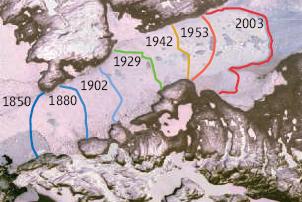
Three Papers in the current issue of Science show the rapid changes that are occurring in world's glaciers.
Paleoclimatic Evidence for Future Ice-Sheet Instability and Rapid Sea-Level Rise
Jonathan T. Overpeck, Bette L. Otto-Bliesner, Gifford H. Miller, Daniel R. Muhs, Richard B. Alley, and Jeffrey T. Kiehl
Science 24 March 2006: 1747-1750.
Simulating Arctic Climate Warmth and Icefield Retreat in the Last Interglaciation
Bette L. Otto-Bliesner, Shawn J. Marshall, Jonathan T. Overpeck, Gifford H. Miller, Aixue Hu, and CAPE Last Interglacial Project members
Science 24 March 2006: 1751-1753.
Measurements of Time-Variable Gravity Show Mass Loss in Antarctica
Isabella Velicogna and John Wahr
Science 24 March 2006: 1754-1756.
Published online 2 March 2006 [DOI: 10.1126/science.1123785] (in Science Express Reports)
Press for these papers:
Sea rise could be 'catastrophic' (BBC)
Polar Meltdown Near: Seas Could Rise 3 Feet Per Century (Livescience)
Thursday, March 23, 2006
Ediacaran website
 Vendia rachiata (?) which looks a bit like a trilobite but probably isn't
While browsing the internet for information on those strange ediacaran creatures I stumbled upon this russian website: http://vend.paleo.ru/ If you are interested in these mysterious creatures it's worth a look.
Although it is all in russian Babelfish does a fairly decent translation, here is their description of the site:
"Our laboratory is occupied by the complex of the early stages of the evolution of biosphere, which preceded the phanerozoic jump of bioraznoobraziya. Special attention in this case is paid to the vendskomu period as to the period, which completes the Proterozoic stage of the evolution of biosphere. For a long time considered as the almost silent, this section of geological chronicle is at the present time remarkable with this number of surprising findings of the remainders of undoubtedly organic nature, that it is possible to indicate that we already see the letters, which wrote the history of the evolution of the biosphere of that time, but yet we cannot understand entire text, which is collected by these letters. On this site are assembled the meaningful results of the work of our laboratory, materials about the directions of research activity, most significant publications, debatable materials."
Being russian they call this period (from the gaskiers glaciation to the cambrian, 632-542 MYA) the vendian even though the internationally accepted name is now the ediacaran.
There is lots of interesting stuff there, the best stuff is probably a nice selection of papers in english and russian that can be downloaded: http://vend.paleo.ru/pub_ru.php & http://vend.paleo.ru/pub_eng.php. Particularly good is 'Ivantsov Malakhovskaya 2003' which is in russian and has some amazing images of ediacaran fossils.
Their research is mainly conducted on the remarkable fossils found in cliffs by the white sea in russia. Other ediacaran localities are the Ediacra hills Australia, Mistaken point Canada, Charnwood in England and Namibia.
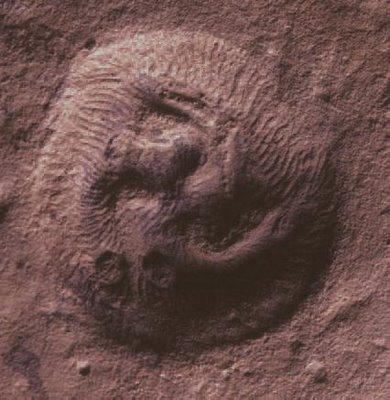 Tribrachidium heraldicum - deeply weird
Their research is mainly conducted on the remarkable fossils found in cliffs by the white sea in russia. Other ediacaran localities are the Ediacra hills Australia, Mistaken point Canada, Charnwood in England and Namibia.
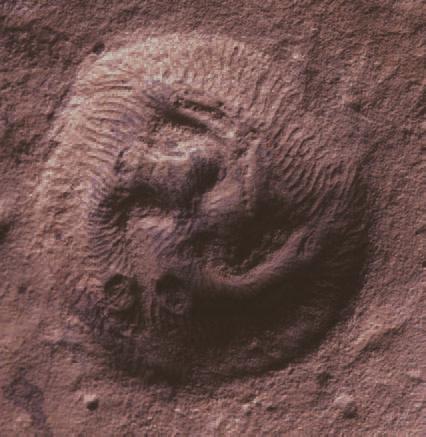 Tribrachidium heraldicum - deeply weird
Tuesday, March 21, 2006
sharovipteryx
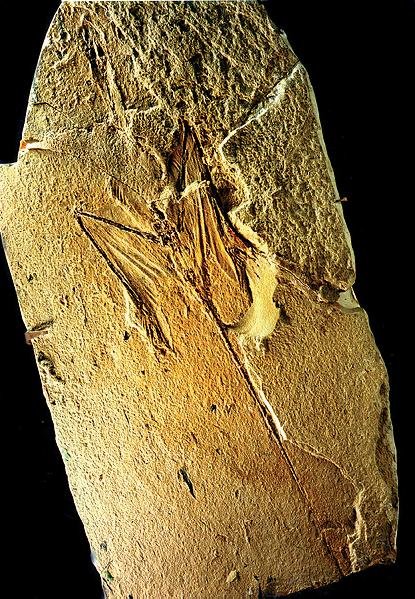
The only fossil specimen of Sharovipteryx mirabilis
Sharovipteryx mirabilis is one of the odder creatures to be found in the fossil record notable because it seems to have wings on it's hind limbs which seems to be a unique adaptation.
A new paper is in press in the Journal of Evolutionary Biology that proposes a model of how this strange beast would have flown. Their reconstruction is shown below. I have no idea if this is actually what the creature would have looked like but it seems like a fairly logical interpretation of the fossil.
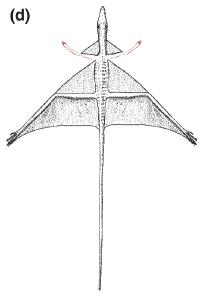 Flight of Sharovipteryx mirabilis: the world’s first delta-winged
glider. G. J. DYKE, R. L. NUDDS & J. M. V. RAYNER. Journal evolutionary biology (in press) doi:10.1111/j.1420-9101.2006.01105.x
Wednesday, March 15, 2006
Frog spawn


The common frog (Rana temporaria) mating and spawning season is in full swing in the garden pond. There is a fairly large amount of spawn this year. Although thats only half the battle, lets hope there isn't another really cold snap so it doesn't all die, and that it stays healthy so there is a nice big crop of froglets this year.
I have a lingering fondness for frogspawn after playing with it when i was young and I still remember being fascinated watching the tadpoles develop. I am sure that is one of the things that made me interested in biology and conservation.
Links:
Declining Amphibians Population Task Force (DAPTF)
herpetofauna
froglife
Monday, March 13, 2006
How to buy fish with a clear conscience
There is a nice article in todays Independent called 'How to buy fish with a clear conscience'
"For years, the unpalatable details of the industry that delivers fish to supermarket shelves have been a well-kept secret, along with the scientific data that shows that some fish are being fished to near-extinction. But not any longer.
The ranks of enlightened fish consumers grow by the day, and proof that some of the supermarkets are waking up to the issue arrived when Greenpeace scaled the Asda headquarters in Leeds in January. No sooner was a banner unfurled from the roof depicting some of the dead and mutilated by-catch, than the campaigners were ushered inside for a chat about the sustainability of the supermarket's fish-buying policies.
Asda, which was rock bottom of a Greenpeace table of supermarkets ranked on their fish-buying policies several months ago, and in the bottom half of a similar Marine Conservation Society (MCS) table published earlier this month, announced immediately that it was removing skate wings, Dover sole, ling and dogfish from its stores. Since Asda's move, Sainsbury's has announced that it will no longer sell skate and huss, both endangered, while in the US, the discount giant Wal-Mart (which owns Asda) has declared that it will buy all of its fresh fish from sustainable sources within three to five years.
.....
Not all fish are so problematic. Lemon sole, red mullet, red gurnard and most salmon are generally acceptable, while Atlantic halibut, skate, swordfish and marlin are not. If a blue certification logo (a fish and a tick) is stamped on a product, it is one of the 50 products accredited by the Marine Stewardship Council, and is sustainable."
Marine conservation is a very important area that is often ignored because of the fishing lobby. This has led to awful mismanagement of fish resources, lets hope that consumer power can change things.
Some resources:
marine conservation society report mentioned in the article: http://www.mcsuk.org/press/press_release.php?cust_id=62
fish online
greenpeace sustainable fish campaign
Marine Stewardship Council
Marine Conservation Biology Institute
save the high seas
What You Can Do to Save the Deep Sea
"For years, the unpalatable details of the industry that delivers fish to supermarket shelves have been a well-kept secret, along with the scientific data that shows that some fish are being fished to near-extinction. But not any longer.
The ranks of enlightened fish consumers grow by the day, and proof that some of the supermarkets are waking up to the issue arrived when Greenpeace scaled the Asda headquarters in Leeds in January. No sooner was a banner unfurled from the roof depicting some of the dead and mutilated by-catch, than the campaigners were ushered inside for a chat about the sustainability of the supermarket's fish-buying policies.
Asda, which was rock bottom of a Greenpeace table of supermarkets ranked on their fish-buying policies several months ago, and in the bottom half of a similar Marine Conservation Society (MCS) table published earlier this month, announced immediately that it was removing skate wings, Dover sole, ling and dogfish from its stores. Since Asda's move, Sainsbury's has announced that it will no longer sell skate and huss, both endangered, while in the US, the discount giant Wal-Mart (which owns Asda) has declared that it will buy all of its fresh fish from sustainable sources within three to five years.
.....
Not all fish are so problematic. Lemon sole, red mullet, red gurnard and most salmon are generally acceptable, while Atlantic halibut, skate, swordfish and marlin are not. If a blue certification logo (a fish and a tick) is stamped on a product, it is one of the 50 products accredited by the Marine Stewardship Council, and is sustainable."
Marine conservation is a very important area that is often ignored because of the fishing lobby. This has led to awful mismanagement of fish resources, lets hope that consumer power can change things.
Some resources:
marine conservation society report mentioned in the article: http://www.mcsuk.org/press/press_release.php?cust_id=62
fish online
greenpeace sustainable fish campaign
Marine Stewardship Council
Marine Conservation Biology Institute
save the high seas
What You Can Do to Save the Deep Sea
Monday, March 06, 2006
cool origami
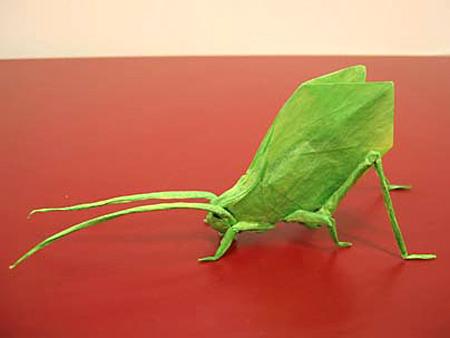
There are some amazing origami design created for ther MIT origami competition (via) Two of the winners are Jason Ku and Brian Chan and several neat designs are available from their websites. The cool Katydid in the picture is by Brian Chan (link) and there are several other nice insect designs available on his website.
Friday, March 03, 2006
Awesome micrographs

Veliger larva of the gastropod, Fusitriton oregonensis by Louise Page
 Posterior of juvenile kinorhynch, Pycnophyes kielensis by Andreas Schnidt-Rhaesa
Copulatory organs of the acoel, Haplocelis dichona by Matthew Hooge
All images & captions from here
These remarkable images are produced by Confocal Laser Scanning Microscopy and show what amazing detail modern technology can reveal.
The images were presented at a conference called 'The New Microscopy: Novel Characters and the Importance of Morphology in Phylogenetic Analysis'. Several papers from this conference are now avilable from the journal Integrative and Comparative Biology which seems to be open access. Lots of interesting stuff has appeared in that journal, the archives are well worth a browse.
Here are the relavent papers:
Sunday, February 26, 2006
Pro-test
After reading about the pro-test march in oxford via scientific activist I decided it was time to not just be annoyed at the awful behaviour of the 'animal rights' extremists and show support for the oxford lab and scientific research in general. So I went to oxford and waved a placard and shouted a bit. Here is a pic of me doing that stuff:
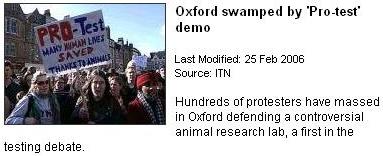
I am the one with the placard from
It was a really good march, the turnout was much larger than I expected (500-800) and dwarfed the rival demonstration (150-200). Everyone was very calm in contrast to the 'animal rights' protest which are marked by scuffles with the police. I guess it's the difference between people who have made a rational choice and fanatics who have lost all sense of perspective in pursuit of their ideology.
While in oxford I had time to check out the attractions such as the Pitt Rivers Museum, Museum of the History of Science (lovely astrolabes) and the Oxford University Museum of Natural History.
Some Links:
The Founder of Pro-test, Laurie Pycroft's livejournal: http://sqrrl101.livejournal.com/
The research defence society: http://www.rds-online.org.uk/ & Blog: http://www.rdsblog.info/
Pro-test: http://www.pro-test.org.uk/
Various blog posts about the protest: Here, here, here, here and here
Update:
The Scientific Activist has an excellent post on the demo: http://scientificactivist.blogspot.com/2006/02/oxford-scientists-bite-back-at-animal.html
Tuesday, February 21, 2006
Coco Pops Straws
"Which? has today complained to the Advertising Standards Authority that the Kellogg's Coco Pops Straws TV advert is misleading and socially irresponsible by marketing a chocolate straw biscuit as a way to get children to drink more milk. "
http://www.which.net/press/releases/food/060221_kellogs_nr.html
Who would have thought that Nestle would produce deceptive adverts for unheathy food?
Nearly everything marketed as being 'healthy' is a con, you end up paying more for stuff that is worse for you than unprocessed foods.
It seems that now the companies that have spent vast amounts of money turning us into junk food addicts have now realised that they can make more money by flogging fake cures for the ailments that they have created.
http://www.which.net/press/releases/food/060221_kellogs_nr.html
Who would have thought that Nestle would produce deceptive adverts for unheathy food?
Nearly everything marketed as being 'healthy' is a con, you end up paying more for stuff that is worse for you than unprocessed foods.
It seems that now the companies that have spent vast amounts of money turning us into junk food addicts have now realised that they can make more money by flogging fake cures for the ailments that they have created.
More global warming
The Arctic and global warming
Researcher describes possible disruption to marine mammals' food web
Studying Arctic phytoplankton has played prominently in Smith's research. Here, Smith (left) is shown on the Coast Guard ice breaker HEALY in 2004, recovering plankton nets.
A warmer Arctic Ocean may mean less food for the birds, fish, and baleen whales and be a significant detriment to that fragile and interconnected polar ecosystem, and that doesn't bode well for other ocean ecosystems in the future. That's the word from University of Miami Rosenstiel School's Dr. Sharon Smith who will speak on "Potentially Dramatic Changes in the Pelagic Ecosystems of the Marginal Seas of the Arctic Ocean due to Anthropogenic Warming," today at 3 p.m. HST (8 p.m. EST) in Honolulu at the American Geophysical Union's 2006 Ocean Sciences Meeting.
See also: Observations of Anthropogenic Climate Change in the Oceans and Their Implications for Society II
And more Oceanic acidity
BBC four is having a 'global warming' season, This would be brilliant if anybody actually watched BBC four, but at least it shows willing. The first programme 'Meltdown' was pretty good and presented the case that current global warming is caused by anthropogenic emissions well.
As part of this season they are running an experiment in which you can download a climate simulation that runs on home computers (windows/linux only). If you can give it a try and hopefully you will be contributing to a useful project.
http://www.bbc.co.uk/sn/hottopics/climatechange/
Researcher describes possible disruption to marine mammals' food web
Studying Arctic phytoplankton has played prominently in Smith's research. Here, Smith (left) is shown on the Coast Guard ice breaker HEALY in 2004, recovering plankton nets.
A warmer Arctic Ocean may mean less food for the birds, fish, and baleen whales and be a significant detriment to that fragile and interconnected polar ecosystem, and that doesn't bode well for other ocean ecosystems in the future. That's the word from University of Miami Rosenstiel School's Dr. Sharon Smith who will speak on "Potentially Dramatic Changes in the Pelagic Ecosystems of the Marginal Seas of the Arctic Ocean due to Anthropogenic Warming," today at 3 p.m. HST (8 p.m. EST) in Honolulu at the American Geophysical Union's 2006 Ocean Sciences Meeting.
See also: Observations of Anthropogenic Climate Change in the Oceans and Their Implications for Society II
And more Oceanic acidity
BBC four is having a 'global warming' season, This would be brilliant if anybody actually watched BBC four, but at least it shows willing. The first programme 'Meltdown' was pretty good and presented the case that current global warming is caused by anthropogenic emissions well.
As part of this season they are running an experiment in which you can download a climate simulation that runs on home computers (windows/linux only). If you can give it a try and hopefully you will be contributing to a useful project.
http://www.bbc.co.uk/sn/hottopics/climatechange/
Monday, February 20, 2006
Arabic calligraphy


 Beautiful calligraphy by mouneer al shaarani There's more at his Gallery (via).
See also The Art of Arabic Calligraphy
Arabic calligraphy
Ugly Criminals?
This story in the Washington post 'The Ugly Face of Crime' is being widely discussed. The original article on which this story is based is based on 'Ugly Criminals' by H. Naci Mocan and Erdal Tekin:
ABSTRACT
Using data from three waves of Add Health we find that being very attractive reduces a young adult’s (ages 18-26) propensity for criminal activity and being unattractive increases it for a number of crimes, ranging from burglary to selling drugs. A variety of tests demonstrate that this result is not because beauty is acting as a proxy for socio-economic status. Being very attractive is also positively associated adult vocabulary test scores, which suggests the possibility that beauty may have an impact on human capital formation. We demonstrate that, especially for females, holding constant current beauty, high school beauty (pre-labor market beauty) has a separate impact on crime, and that high school beauty is correlated with variables that gauge various aspects of high school experience, such as GPA, suspension or having being expelled from
school, and problems with teachers. These results suggest two handicaps faced by unattractive individuals. First, a labor market penalty provides a direct incentive for unattractive individuals toward criminal activity. Second, the level of beauty in high school has an effect on criminal propensity 7-8 years later, which seems to be due to the impact of the level of beauty in high school on human capital formation, although this second avenue seems to be effective for females only. (PDF)
It's tough being a minger.
ABSTRACT
Using data from three waves of Add Health we find that being very attractive reduces a young adult’s (ages 18-26) propensity for criminal activity and being unattractive increases it for a number of crimes, ranging from burglary to selling drugs. A variety of tests demonstrate that this result is not because beauty is acting as a proxy for socio-economic status. Being very attractive is also positively associated adult vocabulary test scores, which suggests the possibility that beauty may have an impact on human capital formation. We demonstrate that, especially for females, holding constant current beauty, high school beauty (pre-labor market beauty) has a separate impact on crime, and that high school beauty is correlated with variables that gauge various aspects of high school experience, such as GPA, suspension or having being expelled from
school, and problems with teachers. These results suggest two handicaps faced by unattractive individuals. First, a labor market penalty provides a direct incentive for unattractive individuals toward criminal activity. Second, the level of beauty in high school has an effect on criminal propensity 7-8 years later, which seems to be due to the impact of the level of beauty in high school on human capital formation, although this second avenue seems to be effective for females only. (PDF)
It's tough being a minger.
Oceans may soon be more corrosive than when the dinosaurs died
This could be a far bigger problem than temperature rise:
"Increased carbon dioxide emissions are rapidly making the world's oceans more acidic and, if unabated, could cause a mass extinction of marine life similar to one that occurred 65 million years ago when the dinosaurs disappeared. Ken Caldeira of the Carnegie Institution's Department of Global Ecology will present this research at the AGU/ASLO Ocean Sciences meeting in Honolulu, HI on Monday, Feb 20.
Caldeira's computer models have predicted that the oceans will become far more acidic within the next century. Now, he has compared this data with ocean chemistry evidence from the fossil record, and has found some startling similarities. The new finding offers a glimpse of what the future might hold for ocean life if society does not drastically curb carbon dioxide emissions.
"The geologic record tells us the chemical effects of ocean acidification would last tens of thousands of years," Caldeira said. "But biological recovery could take millions of years. Ocean acidification has the potential to cause extinction of many marine species."
When carbon dioxide from the burning of coal, oil, and gas dissolves in the ocean, some of it becomes carbonic acid. Over time, accumulation of this carbonic acid makes ocean water more acidic. When carbonic acid input is modest, sediments from the ocean floor can buffer the increases in acidity. But at the current rate of input--nearly 50 times the natural background from volcanoes and other sources--this buffering mechanism is overwhelmed. Previous estimates suggest that in less than 100 years, the pH of the oceans could drop by as much as half a unit from its natural value of 8.2 to about 7.7. (On the pH scale, lower numbers are more acidic and higher numbers are more basic.)
This drop in ocean pH would be especially damaging to marine animals such as corals that use calcium carbonate to make their shells. Under normal conditions the ocean is supersaturated with this mineral, making it easy for such creatures to grow. However, a more acidic ocean would more easily dissolve calcium carbonate, putting these species at particular risk.
The last time the oceans endured such a drastic change in chemistry was 65 million years ago, at about the same time the dinosaurs went extinct. Though researchers do not yet know exactly what caused this ancient acidification, it was directly related to the cataclysm that wiped out the giant beasts. The pattern of extinction in the ocean is consistent with ocean acidification--the fossil record reveals a precipitous drop in the number of species with calcium carbonate shells that live in the upper ocean--especially corals and plankton. During the same period, species with shells made from resistant silicate minerals were more likely to survive.
The world's oceans came close to an acidic catastrophe one other time about 55 million years ago, when the temperature of the Earth spiked and large amounts of methane and/or carbon dioxide flooded the atmosphere. There is no evidence, however, that this caused a mass extinction event.
"Ultimately, if we are not careful, our energy system could make the oceans corrosive to coral reefs and many other marine organisms," Caldeira cautions. "These results should help motivate the search for new energy sources, such as wind and solar, that can fuel economic growth without releasing dangerous carbon dioxide into the environment."
http://www.eurekalert.org/pub_releases/2006-02/ci-oms021706.php
Carbon Dioxide and Ocean Chemistry Change: What Does the Geologic Record Tell us About the Future (session abstract)
"Increased carbon dioxide emissions are rapidly making the world's oceans more acidic and, if unabated, could cause a mass extinction of marine life similar to one that occurred 65 million years ago when the dinosaurs disappeared. Ken Caldeira of the Carnegie Institution's Department of Global Ecology will present this research at the AGU/ASLO Ocean Sciences meeting in Honolulu, HI on Monday, Feb 20.
Caldeira's computer models have predicted that the oceans will become far more acidic within the next century. Now, he has compared this data with ocean chemistry evidence from the fossil record, and has found some startling similarities. The new finding offers a glimpse of what the future might hold for ocean life if society does not drastically curb carbon dioxide emissions.
"The geologic record tells us the chemical effects of ocean acidification would last tens of thousands of years," Caldeira said. "But biological recovery could take millions of years. Ocean acidification has the potential to cause extinction of many marine species."
When carbon dioxide from the burning of coal, oil, and gas dissolves in the ocean, some of it becomes carbonic acid. Over time, accumulation of this carbonic acid makes ocean water more acidic. When carbonic acid input is modest, sediments from the ocean floor can buffer the increases in acidity. But at the current rate of input--nearly 50 times the natural background from volcanoes and other sources--this buffering mechanism is overwhelmed. Previous estimates suggest that in less than 100 years, the pH of the oceans could drop by as much as half a unit from its natural value of 8.2 to about 7.7. (On the pH scale, lower numbers are more acidic and higher numbers are more basic.)
This drop in ocean pH would be especially damaging to marine animals such as corals that use calcium carbonate to make their shells. Under normal conditions the ocean is supersaturated with this mineral, making it easy for such creatures to grow. However, a more acidic ocean would more easily dissolve calcium carbonate, putting these species at particular risk.
The last time the oceans endured such a drastic change in chemistry was 65 million years ago, at about the same time the dinosaurs went extinct. Though researchers do not yet know exactly what caused this ancient acidification, it was directly related to the cataclysm that wiped out the giant beasts. The pattern of extinction in the ocean is consistent with ocean acidification--the fossil record reveals a precipitous drop in the number of species with calcium carbonate shells that live in the upper ocean--especially corals and plankton. During the same period, species with shells made from resistant silicate minerals were more likely to survive.
The world's oceans came close to an acidic catastrophe one other time about 55 million years ago, when the temperature of the Earth spiked and large amounts of methane and/or carbon dioxide flooded the atmosphere. There is no evidence, however, that this caused a mass extinction event.
"Ultimately, if we are not careful, our energy system could make the oceans corrosive to coral reefs and many other marine organisms," Caldeira cautions. "These results should help motivate the search for new energy sources, such as wind and solar, that can fuel economic growth without releasing dangerous carbon dioxide into the environment."
http://www.eurekalert.org/pub_releases/2006-02/ci-oms021706.php
Carbon Dioxide and Ocean Chemistry Change: What Does the Geologic Record Tell us About the Future (session abstract)
Saturday, February 18, 2006
The Myth of Sexual Selection?
In the latest issue of Science Joan Roughgarden has written a review that challenges current ideas about sexual selection.
"Theories about sexual selection can be traced back to Darwin in 1871. He proposed that males fertilize as many females as possible with inexpensive sperm, whereas females, with a limited supply of large eggs, select the genetically highest quality males to endow their offspring with superior capabilities. Since its proposal, problems with this narrative have continued to accumulate, and it is our view that sexual selection theory needs to be replaced. We suggest an approach that relies on the exchange of direct ecological benefits among cooperating animals without reference to genetic benefits. This approach can be expressed mathematically in a branch of game theory that pertains to bargaining and side payments."
Science 17 February 2006: Vol. 311. no. 5763, pp. 965 - 969
Reproductive Social Behavior: Cooperative Games to Replace Sexual Selection
Joan Roughgarden, Meeko Oishi, Erol Akçay
(link-science) (link- free pdf)
There is another article describing Roughgarden's theory in California wild called "The Myth of Sexual Selection" and a response by Michael T. Ghiselin: "Sexual Selection"
"Theories about sexual selection can be traced back to Darwin in 1871. He proposed that males fertilize as many females as possible with inexpensive sperm, whereas females, with a limited supply of large eggs, select the genetically highest quality males to endow their offspring with superior capabilities. Since its proposal, problems with this narrative have continued to accumulate, and it is our view that sexual selection theory needs to be replaced. We suggest an approach that relies on the exchange of direct ecological benefits among cooperating animals without reference to genetic benefits. This approach can be expressed mathematically in a branch of game theory that pertains to bargaining and side payments."
Science 17 February 2006: Vol. 311. no. 5763, pp. 965 - 969
Reproductive Social Behavior: Cooperative Games to Replace Sexual Selection
Joan Roughgarden, Meeko Oishi, Erol Akçay
(link-science) (link- free pdf)
There is another article describing Roughgarden's theory in California wild called "The Myth of Sexual Selection" and a response by Michael T. Ghiselin: "Sexual Selection"
Friday, February 17, 2006
Interesting new blog
Darren Naish a vertebrate paleontologist from the University of Portsmouth has a nice new blog:
"Welcome to my blog site, which over the next weeks and months will include assorted thoughts and comments on various of the issues that interest me: predominantly, what's going on in the world of tetrapod zoology, and particularly the stuff I'm researching, or involved in. Of special interest to me right now are the dinosaurs of the British Wealden (of course), the intriguing tie-ins between Wealden fossil collectors, Conan Doyle's Lost World and the Piltdown fiasco, convergence between different fossorial tetrapods, manatee evolution, and British big cats (yes, really). More to come on these matters and much more in future, honest."
excellent
His latest post is on basal whales: http://darrennaish.blogspot.com/2006/02/when-whales-walked-land-and-looked.html - interesting stuff
Saturday, February 11, 2006
3D Museum
I have found the website of the 3d museum via palaeoblog:
"Welcome to 3D Museum Website, maintained by the Vertebrate Paleobiology Lab of the University of California, Davis. This site was designed to explore the ways of communicating 3D morphological data over the Internet. The website is slowly under expansion, so please check back every three months or so to see its progress. Please send us suggestions. "
I really like this idea, it makes specimens available to a huge potential audience and they can be viewed and manipulated in ways that would be impossible with real objects. Let's hope this project is successful and continues to grow.
http://palaeoblog.blogspot.com/2006/02/3d-museum-now-on-line.html
http://3dmuseum.org/
"Welcome to 3D Museum Website, maintained by the Vertebrate Paleobiology Lab of the University of California, Davis. This site was designed to explore the ways of communicating 3D morphological data over the Internet. The website is slowly under expansion, so please check back every three months or so to see its progress. Please send us suggestions. "
I really like this idea, it makes specimens available to a huge potential audience and they can be viewed and manipulated in ways that would be impossible with real objects. Let's hope this project is successful and continues to grow.
http://palaeoblog.blogspot.com/2006/02/3d-museum-now-on-line.html
http://3dmuseum.org/
Friday, February 10, 2006
New Herefordshire Lagerstätte fossil
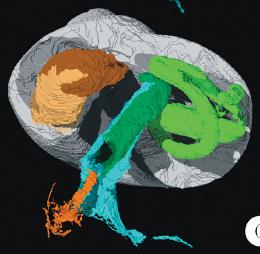
In the last few years many astonishingly well preserved fossils have been discovered in the Herefordshire Lagerstätte. The most amazing feature is that they are preserved in 3 dimensions inside nodules. Because of the way they are preserved the foosils can only be revealed by grinding thin sections of the nodules, taking pictures of the fossils and then reconstructing them in 3d in a computer.
The latest fossil to have been revealed is a platyceratid gastropod and it reveals amazing details of the soft tissue anatomy including "gonads, digestive gland, pedal muscle, radula, mouth and foot" - exceptionally unsual in fossils.
Many more fossil containing nodules have been found at this site but due to the slow process involved in extracting the information from them they have not been looked at yet. I wonder what other amazing fossils are waiting to be revealed.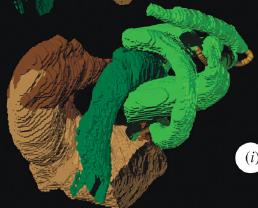
Fossilized soft tissues in a Silurian platyceratid gastropod
M.D. Sutton, D.E.G. Briggs, David J. Siveter, Derek J. Siveter.
Proceedings: Biological Sciences (in press)
http://www.journals.royalsoc.ac.uk/link.asp?id=8332100l0278551q
Some Other related links:
Herefordshire Lagerstätte page: http://www.earth.ox.ac.uk/herefordshire/intro.htm
Three-dimensional preservation of a non-biomineralized arthropod in concretionsin Silurian volcaniclastic rocks from Herefordshire, England PDF
METHODOLOGIES FOR THE VISUALIZATION AND RECONSTRUCTION OF THREE-DIMENSIONAL FOSSILS FROM THE SILURIAN HEREFORDSHIRE LAGERSTÄTTE LINK
Tuesday, February 07, 2006
old maya excavations
 Tikal Temple I 'between 1929 and 1957'
I was browsing the Harvard Visual Information Access database and found that they have loads of old photographs from early excavations of many famous mayan sites such as tikal, copan, palenque, uxmal and chichen itza. It' s fascinating to see how different they look like today:

Tikal temple I today, pic from here
Sunday, February 05, 2006
One Planet, Many People
I have just heard about the atlas 'One Planet, Many People' via the map room and discovered that it is available to download here.
From the press release:
"Produced by the United Nations Environment Programme (UNEP), One Planet Many People: Atlas of our Changing Environment compares and contrasts spectacular satellite images of the past few decades with contemporary ones, some of which have never been seen before.
The huge growth of greenhouses in southern Spain, the rapid rise of shrimp farming in Asia and Latin America and the emergence of a giant, shadow puppet-shaped peninsula at the mouth of the Yellow River are among a string of curious and surprising changes seen from space.
They sit beside the more conventional, but no less dramatic images of rain forest deforestation in Paraguay and Brazil, rapid oil and gas development in Wyoming, United States, forest fires across sub-Saharan Africa and the retreat of glaciers and ice in polar and mountain areas."
It has some really amazing satellite imagery and scarily illustrates the rate of enviromental destruction. It is great that it can be downloaded for free, so that this information can be spread as widely as possible.
Download link: http://www.na.unep.net/OnePlanetManyPeople/AtlasDownload.php
From the press release:
"Produced by the United Nations Environment Programme (UNEP), One Planet Many People: Atlas of our Changing Environment compares and contrasts spectacular satellite images of the past few decades with contemporary ones, some of which have never been seen before.
The huge growth of greenhouses in southern Spain, the rapid rise of shrimp farming in Asia and Latin America and the emergence of a giant, shadow puppet-shaped peninsula at the mouth of the Yellow River are among a string of curious and surprising changes seen from space.
They sit beside the more conventional, but no less dramatic images of rain forest deforestation in Paraguay and Brazil, rapid oil and gas development in Wyoming, United States, forest fires across sub-Saharan Africa and the retreat of glaciers and ice in polar and mountain areas."
It has some really amazing satellite imagery and scarily illustrates the rate of enviromental destruction. It is great that it can be downloaded for free, so that this information can be spread as widely as possible.
Download link: http://www.na.unep.net/OnePlanetManyPeople/AtlasDownload.php
Subscribe to:
Posts (Atom)